Wednesday, November 16, 2016

Giving Tuesday is November 29!

-from the Executive Director


After Black Friday and Cyber Monday, the back-to-back days of deals, join us in kicking off the holiday season of giving November 29: Giving Tuesday!

Giving Tuesday is a global day of giving that unites people and organizations for one common goal: to do good!  Over the past four years #GivingTuesday has empowered more than 45,000 organizations in over 75 countries to give back to their communities.  In 2015 #GivingTuesday raised over $116 million online across the globe- double what was raised in 2014!

Ways to gear up for GivingTuesday:


At the IVDM, we have spent the last year devoted to education. We have seen thousands of kids come through the museum and our festival booths.  It takes a lot of effort to plan and deliver programs, events, and field trips and we now have three new staff in our well-trained education department to help make that happen!  We have already booked half of our field trip days for 2017 and have six festivals on our calendar.


Our Education Department, however, is fully funded by donations.  Our youth programs only happen with your help!
 
What Your Donation Buys:
$400= 1 Fair/Festival Coiled Clay Booth
$200= 1 History on the Go classroom trip
$800= Clay and field trip supplies for a year


Even your donation of just $5 supports one child learning about the cultural history of the early people in the Southern California deserts.

On Giving Tuesday, November 29, a global day of giving, we are focusing all donations on Education! Help us reach our goal of $6,000 raised by the end of the day November 29. 

You can donate through our online campaign website or mailing a check to:

Imperial Valley Desert Museum Society
P.O. Box 2455
El Centro, CA 92244
 Mark your calendars, spread the word, and thank you in advance for your support!

Thursday, November 10, 2016

Between the Joshua Trees


Welcome to the Mojave!
-by Edgar Bernal Sevilla, Curation/Education Staff

The IVDMuseum staff was invited to the Mojave National PreserveConservancy’s  Centennial celebration and Stargazing event by David Lamfrom, the director of the California Desert and Wildlife Programs branch of the National ParksConservation Association. Stargazing took place the first night, NASA telescopes were brought out and I got to see Saturn, my favorite planet since I was a child. I began acting like a child in front of the NASA telescope handlers, since “HOLY COW YOU CAN SEE THE RINGS!” It was truly a fulfilling moment. 

Edgar in Joshua Tree forest
The next day we went on a hike led by Superintendent of the Mojave National Preserve Todd Suess. We wove through canyons in a familiar desert landscape. However, once past these canyons, we were faced with an unnatural, unfamiliar view. A mile-long dome erupted from the desert floor, and the vegetation changed from familiar chollas and desert shrubs to alien-looking Joshua Trees. I had never seen a Joshua Tree before, so I was fascinated by these “medium-sized-normal-tree-shaped palm trees.” It was also my luck that I was going through the densest Joshua Tree forest in the world!


Edgar & Angelina at Teutonia Peak Trail
 I didn’t realize at the time that our hike leader Todd was the superintendent of the whole preserve! We chatted about his previous jobs, archaeology and paleontology in the Mojave, and the uses of desert plants like mesquites and cacti. The group soon split up into an advanced party, a medium group, and the laggers. Eager to reach the summit, I was a member of the advance party, along with our board VP Dr. Robert Wishner; Todd; hike leader Jackie (who's also Todd's wife); and two other hikers. When David had described the hike to us in the morning, he made it sound like the last part was tougher but gentle. He may have sugarcoated it for us.

I was out of breath by the time we reached the top. The view was worth it though. Behind us, the dome peaked at around our altitude, creating an otherworldly view of melted land with a bubble about to burst. To our sides, rocks greeted us, showing that we weren’t on the mountain’s true summit. In front, mountains extended as far as the eye could see: David Lamfrom pointed to the furthest back and informed us that they were the rim of Death Valley. With my senses overloaded, I decided to lay down on a flat rock and enjoy the gentle winter desert sun. This was my favorite part of the hike. The combination of warm light, cool breeze, and riveting stories made for a fantastic blend of an experience. My favorite story was told by Todd. He told us of a train robbery in the desert, but that instead of gold bullion of passengers wallets, the booty was flatscreens. You read that right. This took place in 2004!

Anyway, this turned out to be a fantastic experience. There is a current of longing for nature running through the social fabric of young adults. I am no exception. A trip like this really helped soothe the part of my soul that itches to experience nature and all of its gifts. And it seems the event was a success, since I can’t wait to bring out my friends. In fact, this blog post is the first in a weekly series of hiking posts that I plan to initiate after this. Hiking adventures await!

Hiking adventure awaits!


Sunday, November 6, 2016

Hiking "Coast to Cactus"

-from Anne C Morgan, Head Curator

Canyoneers Stacey and Rochelle with Ramses
As the weather cools and the season for enjoying the outdoors begins, thoughts turn towards hiking, camping, and exploring the wonderfully diverse region that is Southern California.  Yesterday 25 people came out to the Desert Museum for a book talk to get ready for the season.

San Diego Natural History Museum Canyoneers Rochelle Gaudette and Stacy Vielma came out to talk about hiking, some of their experiences out on the trails, and the new book written by Canyoneers and published by Sunbelt Publications Coast to Cactus The Canyoneer Trail Guide to San Diego Outdoors.  "The book is more than just another hiking guide" said Rochelle "it's like having a virtual Canyoneer with you when you can't join us on hikes."  The book looks at the range of habitats found in San Diego County and over 500 species of plants, birds, mammals, reptiles and more that call the area home, as well as natural and cultural features you might find.

Frank & Lidia looking at plant samples
Visitors got to handle samples of local plants and try to identify them.  Some, like the brittle bush, were well known to locals, while other plants looked so similar that the group had to compare them closely before figuring out what was what.  Chamise, buckwheat, Lemonadeberry, Toyon and others were looked at not only for plant comparisons but also to explore what drought adaptations different plants had developed.

"There is no shortage of fun on our hikes" Stacey told the audience. "We encourage people to examine the world and learn about the ecosystems." Whether you are joining the Canyoneer hikes or going out with your own group there are endless things to discover about the natural world around us, from the coast to the desert.
Coast to Cactus book supplements hiking, & San Diego Natural History Museum exhibit


Coast to Cactus exhibit at NAT

Wednesday, November 2, 2016

OctoberCraft Fun

-by Angelina Coble, Education Staff

Matsay the Museum Coyote dressed as Little Red Riding Hood to give out candy
This October I had the opportunity to plan the fun Halloween crafts for our second OctoberCraft event.  It was the first event I have planned here and it was a lot of fun- for both us and the kids! After visiting for two and a half hours one girl said "It feels like I've only been here 15 minutes!" We had 7 activity stations spread through the museum:

What's better than game pieces you can eat?
Halloween Bingo: A tasty twist on traditional Bingo, the kids got to fill their playing cards with candy
corn.  What's more fun than being able to eat your game pieces?

Foam crafts: The kids were able to put together foam Halloween decorations like pumpkins, ghosts, and frogs, then decorate their costumes, bags or other crafts!
Mason Jars with volunteers
Mason Jar Lanterns: One very popular craft was decorating mason jars.  The kids used glue, tissue paper, and a little paint to make decorative lanterns.  At home an electric tea light will make them shine, and several kids used them during the event to store Halloween candy!

Making a clay spider
Clay: The art of getting your hands dirty!  Everyone enjoyed using their creative skills to sculpt skulls and other figures and, after their masterpieces dried a bit they got to add paint.

Stringing acorns for necklace
Acorn necklaces: The older kids especially liked this activity where they made necklaces and bracelets by stringing colorful beads and acorns together in great combinations.
Dia de los Muertos workshop: Bob Diaz, from El Centro Sears, once again came out to do a wonderful workshop exploring the tradition of Dia de los Muertos.  Kids and adults both discovered more about a holiday they thought they already knew, and made colorful masks for their loved ones.


Shaahuk!
Shaahuk: If you thought Monopoly and Sorry! are competitive games, you should try this!  Shaahuk is a traditional Kumeyaay game where you have to be the first to get your game pieces around the circle representing the Milky Way.  The game was a big hit, children and their parents got very competitive trying to win.  One of the rules of the game is: if a player lands on an occupied space the first player gets sent back to the beginning. So you can see how the game can build up tension!


We had over 76 people come out on Sunday- many in costume!- for our event.  The reason we are able to host these events is thanks to the help and support of our board members, volunteers, and enthusiastic visitors.  We hope to see you all out again for next year's event!  A big thanks to all of you who made this event possible!

Next time you stop by the museum, don't be afraid to challenge me to a game of Shaahuk.  regardless of what anyone else tells you, I still consider myself the reigning champ!

Sunday, October 23, 2016

Borrego Days Open House

-from the Head Curator

Beautiful blue skies in Anza-Borrego Desert State Park
Mammoth skull in plaster cast
Saturday, October 22 and Sunday October 23 are the Borrego Days Open Houses at the Anza-Borrego Foundation's Visitor Center, Archaeology and Paleontology labs.  Saturday, Head Curator Anne Morgan and Curation/Education staff Edgar Bernal Sevilla drove out to Borrego Springs to attend the open houses and talk with some volunteers and specialists.  Many of their volunteers have also been volunteers at the Desert Museum and helped curate large collections of artifacts here.


Volunteers removing part mammoth tusk from plaster cast


The theme for the Paleontological Society this year was "Ancient Horses of Anza-Borrego"
and experts were on hand to show visitors bones of the ancient horses who lived in the park region, as well as comparisons with bones from modern horses.  Several volunteers were working on carefully removing a mammoth tusk from its' plaster cast and talked to Anne and Edgar about the techniques paleontologists used on excavations.  The method of removing animal bones by covering them in plaster to protect them during transport hasn't changed since the early days of paleontological work!


Giant tortoise shell, upside down, still partially in plaster cast
A giant tortoise was also having its' cast removed.  The tortoise was thought to have lived about 2 million years ago, and it was on its' fifth year of having the cast removed.


Fossil echinoid discovered by Morlin Childers and given scientific name  Schizaster morlini in his honor

Edgar was especially excited to meet volunteer Linda Gilbert, who has been working on the recently acquired Morlin Childers paleontological collection.  Since Edgar is working in the Childers archaeology collection recently brought to the Desert Museum, the two had lots of stories to share! Staff were also honored to meet George T. Jefferson, the park's (now retired) paleontologist who talked with them about mammoth bones found by IVC's George Miller in 1986.

It was great seeing so many people out celebrating Borrego Days and enjoying discovering more about the amazing stories found right there in Anza-Borrego Desert State Park. We hope some of you got the chance to go out and participate!

Edgar's selfie with a saber-toothed cat 


Saturday, October 15, 2016

Sign of Things to Come


-from Marcie Rodriguez, Education Coordinator

I spent my Wednesday working with Dan Evers 
from the Rainforest Art Project, an organization that is a nature and history-based, educational, healing arts program inspiring children and their families by building a sense of pride and ownership through the creation of permanent ceramic and mosaic art. We have begun to work together to build an entry sign for the Imperial Valley Desert Museum with the students from Seeley Unified School District. This is of particular excitement for me, as I am from Seeley, and my daughter attends the school. This makes this project extremely personal, as the kids I am working with are not simply kids I met on this project, but they are my neighbors, my daughter's friends, and a part of my personal community. 

My daughter helping us with the sign! 

The sign is going to be gorgeous. There are brilliantly colored glass peices that are being placed in a mosaic that will reflect the beautiful natural landscape that surrounds the museum. It will feature native plants, like to ocotillo, and animals, including a roadrunner and a scorpion. While teaching students about the process of making a glass mosaic, I hope to teach them a little bit about their home as well. This will be a fantastic project to be able to work with these students to show them how art, science, and history are not isolated subjects, but are deeply entertwined with each other. 
Dan Evers working with students!
The completed sign will greet visitors as they turn onto Frontage Road towards the Museum.  It has been partially financed with a grant from the Imperial Valley Community Foundation and partially funded by a public benefits grant sponsored by Jack Terrazas with the Imperial County Board of Supervisors.

Friday, October 14, 2016

A Timeless Puzzle

-from Edgar Bernal Sevilla, Curation/Education Staff

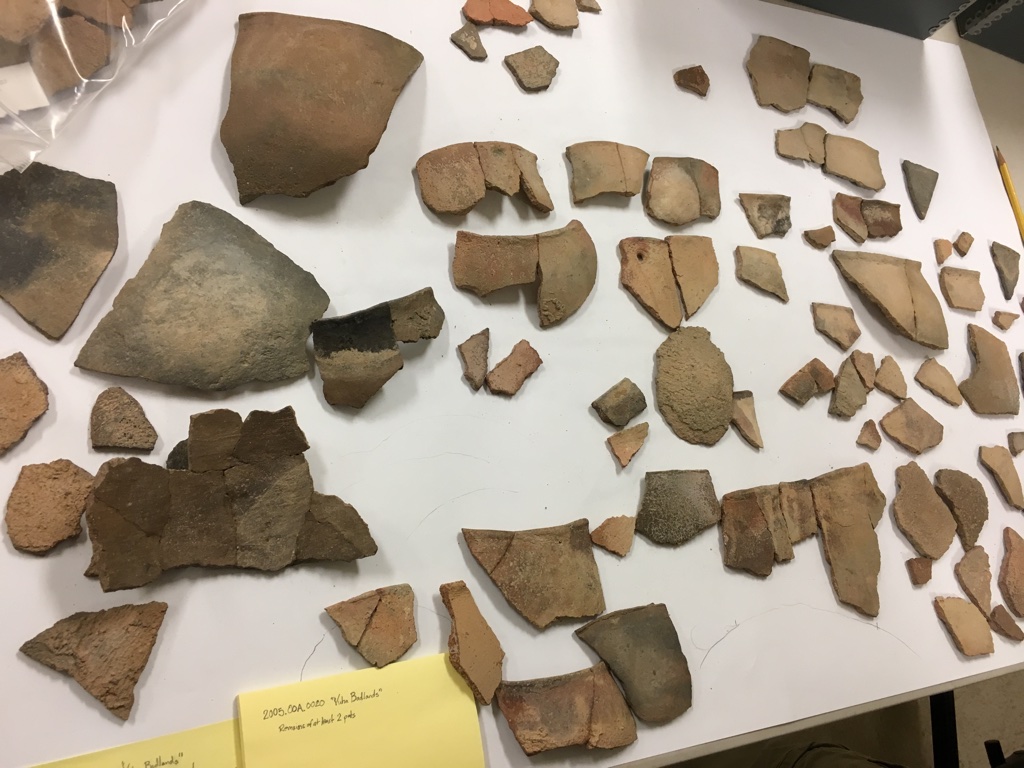
Edgar Bernal Sevilla examining ceramic sherds from Yuha Desert, IVDM collection 
Today was one of those days that, long after I move on from the Imperial Valley Desert Museum (hopefully a very, very long time from now), I will fondly look back at with a wisp of a smile on my face.  Like when I decided to try my hand at flintknapping, I was itching for something out of the ordinary. The opportunity came when Neal decided figuring out what the desert Kumeyaay were eating in the Yuha Desert was of the utmost importance. And thus, a new adventure began.


Looking at archaeology as a 3-D ceramic puzzle  
To save us all from details that are most likely only interesting to me, we’ll skip to the part when I at long last found the droids- erm . . .- pottery sherds I was looking for. Had I known as a kid I would be putting ancient pottery sherds together like a jigsaw puzzle in order to send them to get chemical analysis, I would’ve sent myself a giant, paradoxical, time-breaking high five. 


Yuha Desert ceramic sherds, IVDM collection
I spent a few hours moving pieces and figuring out which ones would be the best for analysis. Anne (our head curator and my direct boss); Lindsay Porras, an archaeological researcher currently working on a Master's of Arts in Applied Archaeology from the Department of Anthropology, California State University, San Bernadino, who happened to be in the building doing research on archaeology around the Salton Sea; and I put our brains together and we came up with a criteria for sherds that would be good candidates for chemical analysis- focusing on potsherds that were the bottom of a vessel used for cooking and therefore the most likely to contain traceable food residue.


Piecing together rims to get size of pot
It’s funny that here at the IVDM, I do quite a bit of work that I feel wildly unqualified to do. I often have thoughts of “am I allowed to touch that?” and, perhaps most tellingly, “you’re asking me to do what!?” I often forget that I am now a museum professional with a history degree who has yet to fail in a task I’ve been assigned that my mind tells me I’m wildly unqualified for. Working out here is empowering, and my professional self esteem is frantically trying to catch up to everything I’m learning and my professional competency level. I’m occasionally asked things by other staff members rather than always being the inquirer. I occasionally suggest changes to the museum to my superiors and, to my amazement, they usually agree. And yes Edgar, you ARE allowed to touch those ancient pottery sherds (with curation gloves on, of course.) In fact, you personally were specifically the one asked to do so. And in doing so, I put together a timeless puzzle, taking another step in my journey as a museum professional, and as a confident human being as a whole.

An adventure in archaeology and being a museum professional