Showing posts with label museum professionals. Show all posts

Friday, October 14, 2016

A Timeless Puzzle

-from Edgar Bernal Sevilla, Curation/Education Staff

Edgar Bernal Sevilla examining ceramic sherds from Yuha Desert, IVDM collection 
Today was one of those days that, long after I move on from the Imperial Valley Desert Museum (hopefully a very, very long time from now), I will fondly look back at with a wisp of a smile on my face.  Like when I decided to try my hand at flintknapping, I was itching for something out of the ordinary. The opportunity came when Neal decided figuring out what the desert Kumeyaay were eating in the Yuha Desert was of the utmost importance. And thus, a new adventure began.


Looking at archaeology as a 3-D ceramic puzzle  
To save us all from details that are most likely only interesting to me, we’ll skip to the part when I at long last found the droids- erm . . .- pottery sherds I was looking for. Had I known as a kid I would be putting ancient pottery sherds together like a jigsaw puzzle in order to send them to get chemical analysis, I would’ve sent myself a giant, paradoxical, time-breaking high five. 
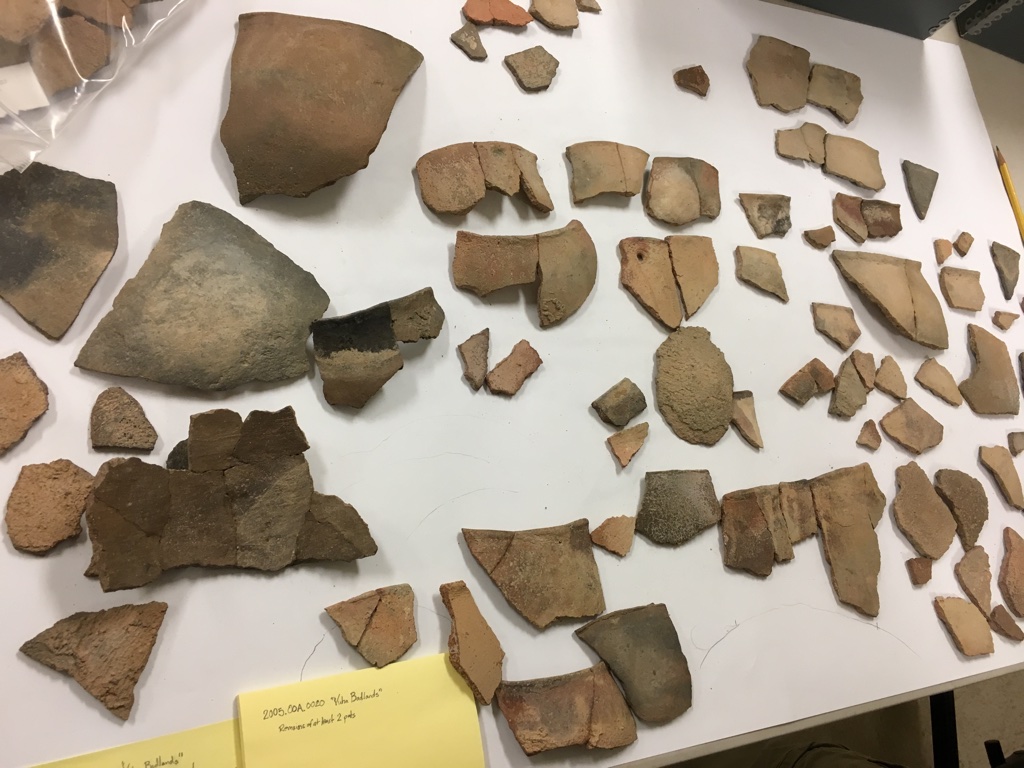


Yuha Desert ceramic sherds, IVDM collection
I spent a few hours moving pieces and figuring out which ones would be the best for analysis. Anne (our head curator and my direct boss); Lindsay Porras, an archaeological researcher currently working on a Master's of Arts in Applied Archaeology from the Department of Anthropology, California State University, San Bernadino, who happened to be in the building doing research on archaeology around the Salton Sea; and I put our brains together and we came up with a criteria for sherds that would be good candidates for chemical analysis- focusing on potsherds that were the bottom of a vessel used for cooking and therefore the most likely to contain traceable food residue.


Piecing together rims to get size of pot
It’s funny that here at the IVDM, I do quite a bit of work that I feel wildly unqualified to do. I often have thoughts of “am I allowed to touch that?” and, perhaps most tellingly, “you’re asking me to do what!?” I often forget that I am now a museum professional with a history degree who has yet to fail in a task I’ve been assigned that my mind tells me I’m wildly unqualified for. Working out here is empowering, and my professional self esteem is frantically trying to catch up to everything I’m learning and my professional competency level. I’m occasionally asked things by other staff members rather than always being the inquirer. I occasionally suggest changes to the museum to my superiors and, to my amazement, they usually agree. And yes Edgar, you ARE allowed to touch those ancient pottery sherds (with curation gloves on, of course.) In fact, you personally were specifically the one asked to do so. And in doing so, I put together a timeless puzzle, taking another step in my journey as a museum professional, and as a confident human being as a whole.

An adventure in archaeology and being a museum professional


Wednesday, September 28, 2016

Small Pupfish in a Big Oasis

-Edgar Bernal Sevilla, Curation/Education Staff

Edgar Bernal Sevilla & Richard Barnes at beginning of conference
This week Richard Barnes, a former museum intern, and I were invited by my boss, Dr. Neal Hitch, to attend my first museum conference as a museum professional.  It was the Western Museums Association Annual Conference in Phoenix, Arizona.  It was both exciting and intimidating, and a great experience.

At our first conference mixer, Neal directed me to get two business cards: one from someone at my general rank, and one from someone with way more experience than me. I ended up succeeding (after a few drinks), emerging from the crowd a few hours later with the business card of a young Chicago saleswoman and a titan in the exhibit design industry. Success! 

Steve Hoza, Nadia Arrambla, Neal Hitch, Berlin Loa
The sessions the next day varied from extremely interesting to somewhat disappointing. I got some fantastic ideas from some sessions, while others were just lectures about what seemed (to me) like common sense. While I was awed at first by talks from museums with hundreds of employees or millions of dollars in their annual budgets, the overall feeling I got from the conference is that our tiny little museum in the middle of nowhere is actually pretty cutting edge. 


Lael Hoff, George Ramirez, Michael Connolly Miskwish, Kelly Hyberger. San Diego Museum of Man
My favorite session had to be one on Tuesday titled “Decolonization of the San Diego Museum of Man.” It is safe to say that it was one of the most diverse panels in the conference. The diversity was also extremely refreshing because you could see different perspectives about a wide variety of topics from different cultures including the Kumeyaay and Hispanic communities.  I was thoroughly impressed with their work decolonizing the San Diego Museum of Man and they seemed to me the model of a diverse organization: one where different backgrounds and perspectives allowed for a much greater effectiveness solving problems to achieve one goal. It was inspiring and I made sure to get a few business cards from SMoM.


Neal Hitch & Edgar Bernal Sevilla at Arizona Science Center
All in all, attending the WMA conference was a fantastic experience. I came back with many new ideas and much stronger confidence in my own abilities as a museum professional. I had never thought about making museum work a career, it always seemed like a means to an end, but coming back from that conference made me feel empowered, like there was no museum problem I couldn’t tackle. Seeing how my little tiny museum stacked up with the rest of the museums in the American West made me more confident. The conference made me feel like I could go anywhere and be more than competent at any facet of museum work (probably not true but that was my feeling). Seeing how many skills I had that other people in larger, more specialized museums don’t have also made me feel extremely capable. I shouldn’t let it get to my head, after all, I have less than a year of experience doing this, but I feel that, if I stick to this profession, I’m going to do alright wherever life takes me.