-from Edgar Bernal Sevilla, Curation/Education Staff
 |
| Edgar Bernal Sevilla examining ceramic sherds from Yuha Desert, IVDM collection |
Today was one of those days that,
long after I move on from the Imperial Valley Desert Museum (hopefully a very, very long time from now), I will fondly look back at with a wisp of a smile on
my face. Like
when I decided to try my hand at flintknapping, I was itching for something out
of the ordinary. The opportunity came when Neal decided figuring out what the
desert Kumeyaay were eating in the Yuha Desert was of the utmost importance.
And thus, a new adventure began.
 |
| Looking at archaeology as a 3-D ceramic puzzle |
To save us all from details that are
most likely only interesting to me, we’ll skip to the part when I at long last
found the droids- erm . . .- pottery sherds I was looking for. Had I known as a kid I
would be putting ancient pottery sherds together like a jigsaw puzzle in order
to send them to get chemical analysis, I would’ve sent myself a giant, paradoxical, time-breaking high five.
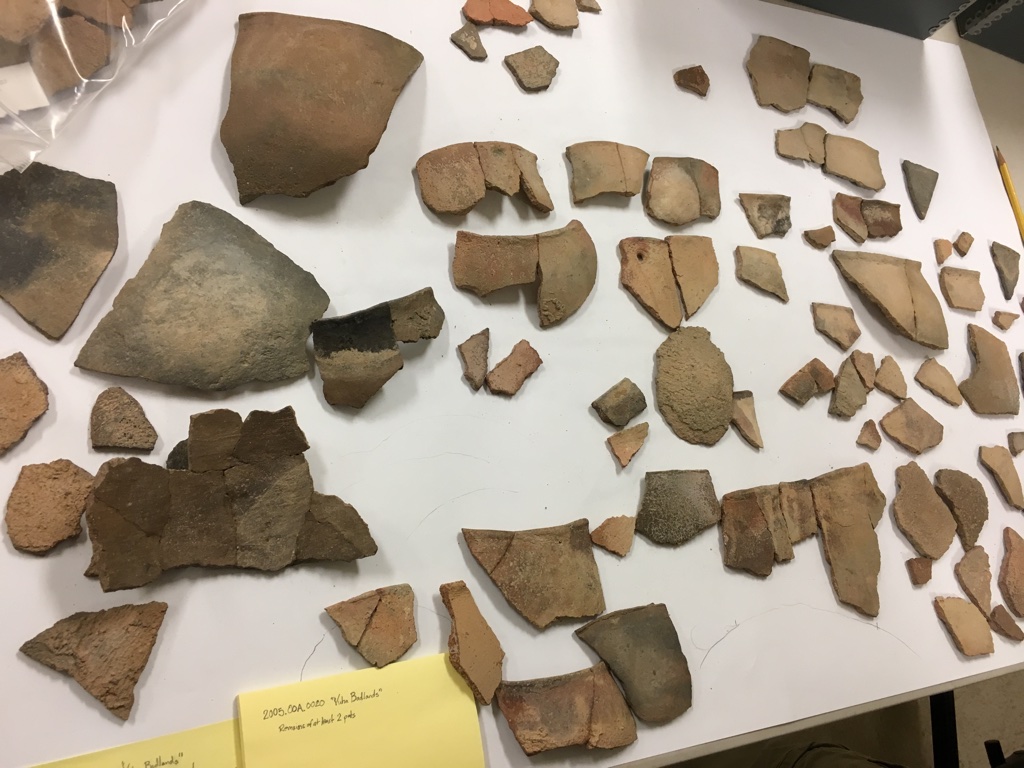 |
| Yuha Desert ceramic sherds, IVDM collection |
I
spent a few hours moving pieces and figuring out which ones would be the best for
analysis. Anne (our head curator and my direct boss); Lindsay Porras, an
archaeological researcher currently working on a Master's of Arts in Applied Archaeology from the Department of Anthropology, California State University, San Bernadino, who happened to be in the building doing research on archaeology around the Salton Sea; and I put our
brains together and we came up with a criteria for sherds that would be good candidates for chemical analysis- focusing on potsherds that were the bottom of a vessel used for cooking and therefore the most likely to contain traceable food residue.
 |
| Piecing together rims to get size of pot |
It’s funny that here at the IVDM, I
do quite a bit of work that I feel wildly unqualified to do. I often have
thoughts of “am I allowed to touch that?” and, perhaps most tellingly, “you’re asking me to do what!?” I often forget
that I am now a museum professional with a history degree who has yet to fail
in a task I’ve been assigned that my mind tells me I’m wildly unqualified for.
Working out here is empowering, and my professional self esteem is frantically
trying to catch up to everything I’m learning and my professional competency
level. I’m occasionally asked things by other staff members rather than always
being the inquirer. I occasionally suggest changes to the museum to my
superiors and, to my amazement, they usually agree. And yes Edgar, you ARE allowed
to touch those ancient pottery sherds (with curation gloves on, of
course.) In fact, you personally were specifically the one asked to do so. And
in doing so, I put together a timeless puzzle, taking another step in my
journey as a museum professional, and as a confident human being as a whole.
 |
| An adventure in archaeology and being a museum professional |


