Showing posts with label museums. Show all posts

Monday, March 5, 2018

Concrete Beginnings

 -Marcie Landeros, Education Coordinator
The concrete base for this amazing sign was poured today! Thank you Home Depot! 


Today was a very exciting day, both for the museum and for me personally. Today we poured the concrete for the foundation of a new sign that will be placed at the off-ramp of the I-8, in Ocotillo. This sign will welcome visitors to the museum and guide them up the road to the driveway. This project has been driven by our community, and it brings me great joy to see it continue to move forward.

Gibson & Schaeffer's cement mixer, pouring a concrete base
This project has been in the works for quite some time. The grant through IV Community Foundation was given in December of 2015, and was then supported by the Imperial Valley Board Supervisor Jack Terrazas. The sign was designed by The Rainforest Art Project, over the course of a year. During the 2016 – 2017 school year, I spent Wednesday afternoons at Seeley Elementary where Rainforest staff taught me how to mosaic, and I in-turn taught the students.


Marcie with Home Depot crew, watching the concrete pour
The finished concrete base: the beginning of the final step for our new sign!
Home Depot not only donated the supplies for the pour, but also provided the museum with volunteers. Home Depot also secured a truck from Gibson and Schaeffer Construction for the pour. Museum staff, board members, and volunteers made quick work of the pour, creating a beautiful foundation for a beautiful mosaic sign. I can't wait until we are inviting Seeley students out here to watch their mosaic get installed!


"Goodbye, Hello!"


-David Breeckner, Interim Museum Director


Today the Imperial Valley Desert Museum made its first steps toward the next stage of its development and offerings.  A group of dedicated volunteers came together to transform an underutilized and underappreciated facility on the Museum’s grounds into a dynamic work space for future arts-based projects and programs.  Join us in saying “goodbye” to the old Information Center (IC) and “hello” to the new Activities & Propagation Center (APC).

Since the closure of the original Imperial Valley College Museum in El Centro, the IC served as a storehouse and repository of its collections and records.  It held this role for many years, until the construction of the new IVDM  building in Ocotillo in 2008.  From then until 2012, its storerooms were emptied and the artifacts carefully transported to their new forever home at the Imperial Valley Desert Museum.  Since that move, the IC has been listless and often relegated to the background of any conversation.  Many, including some of our own membership and Board, have since forgotten the history and importance of its earliest role!

Now, the IVDM Society, Inc looks to revitalize that same facility, giving it new purpose as an outdoor education and activities space.  Moving forward, we hope to see the APC succeed as a place for dedicated cultural art and science programs.  On a busy day at the Museum, it can be difficult to find the space to run our signature coiled clay program, or to design new mosaic signage and artwork.  It is even more difficult to garden, propagating local plants.  The new APC gives the Museum room to grow in all these activities, and more.


In place of a single building on its property, the IVDM now looks to grow into a multi-building, multi-purpose campus.


Today, a team of six volunteered their morning and afternoon to begin the first stage of its transformation.  Working to the musical stylings of the 1950s, 60s, and 70s and the promise of grilled hotdogs, volunteers swept, sorted, and binned the accumulated trash of the last two decades (and beyond).  Looking forward, the IVDM hopes to continue its work on the APC: repairing its sloped roof, repainting the exterior walls, developing its open courtyard, and to complete its design and installation of a planting space for the propagation of the town of Ocotillo’s namesake.

Our “Community BBQ & Clean-up” series has only just begun!  If you would like to get involved, we welcome you to reach out to Museum staff by email, phone, or by just stopping in. 

Monday, September 18, 2017

Project complete! For now

-from Anne C. Morgan

It's hard to believe it's nearly the end of September already.  A month ago I began an intense digitization project with the goal of scanning all photographs in the Harry Casey Collection that connected to geoglyphs.  In a collection of more than 8,000 individual images, I knew the bulk of them pertained to geoglyphs, but what did that mean? All 8,000? 7,000?


30 days, 230.5 hours, and 2 scanners later, the answer is 4,462.  That's the number of photographs scanned, although there were over 1,000 duplicate copies of individual images.


2 scanners worked hard on this project!
What's next? What was the point of becoming the Mad Scanner? I'll be working with photographer Harry Casey and Sunbelt Publications to put together Harry's manuscript with accompanying images for publication.  The museum will apply for grants to create an interactive digital exhibit based on the work.  After that? There are plenty more ideas waiting to be implemented- not to mention almost another 4,000 photographs of rock art, Nazca Lines, and desert plants waiting to be scanned and create exciting, interesting, and beautiful exhibits!


A special thanks to Dr. David Breeckner, Angelina Coble, and Marcie Rodriguez for all their help with this project!


Marcie examines a slide

Sunday, October 23, 2016

Borrego Days Open House

-from the Head Curator

Beautiful blue skies in Anza-Borrego Desert State Park
Mammoth skull in plaster cast
Saturday, October 22 and Sunday October 23 are the Borrego Days Open Houses at the Anza-Borrego Foundation's Visitor Center, Archaeology and Paleontology labs.  Saturday, Head Curator Anne Morgan and Curation/Education staff Edgar Bernal Sevilla drove out to Borrego Springs to attend the open houses and talk with some volunteers and specialists.  Many of their volunteers have also been volunteers at the Desert Museum and helped curate large collections of artifacts here.


Volunteers removing part mammoth tusk from plaster cast


The theme for the Paleontological Society this year was "Ancient Horses of Anza-Borrego"
and experts were on hand to show visitors bones of the ancient horses who lived in the park region, as well as comparisons with bones from modern horses.  Several volunteers were working on carefully removing a mammoth tusk from its' plaster cast and talked to Anne and Edgar about the techniques paleontologists used on excavations.  The method of removing animal bones by covering them in plaster to protect them during transport hasn't changed since the early days of paleontological work!


Giant tortoise shell, upside down, still partially in plaster cast
A giant tortoise was also having its' cast removed.  The tortoise was thought to have lived about 2 million years ago, and it was on its' fifth year of having the cast removed.


Fossil echinoid discovered by Morlin Childers and given scientific name  Schizaster morlini in his honor

Edgar was especially excited to meet volunteer Linda Gilbert, who has been working on the recently acquired Morlin Childers paleontological collection.  Since Edgar is working in the Childers archaeology collection recently brought to the Desert Museum, the two had lots of stories to share! Staff were also honored to meet George T. Jefferson, the park's (now retired) paleontologist who talked with them about mammoth bones found by IVC's George Miller in 1986.

It was great seeing so many people out celebrating Borrego Days and enjoying discovering more about the amazing stories found right there in Anza-Borrego Desert State Park. We hope some of you got the chance to go out and participate!

Edgar's selfie with a saber-toothed cat 


Friday, October 14, 2016

A Timeless Puzzle

-from Edgar Bernal Sevilla, Curation/Education Staff

Edgar Bernal Sevilla examining ceramic sherds from Yuha Desert, IVDM collection 
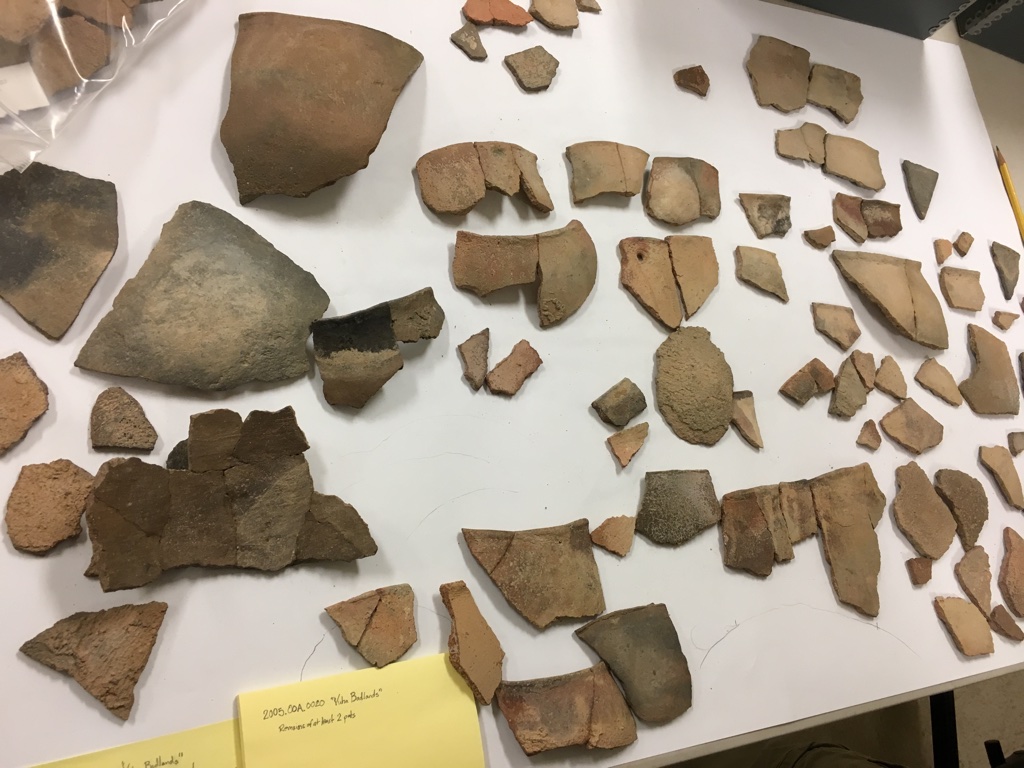
Today was one of those days that, long after I move on from the Imperial Valley Desert Museum (hopefully a very, very long time from now), I will fondly look back at with a wisp of a smile on my face.  Like when I decided to try my hand at flintknapping, I was itching for something out of the ordinary. The opportunity came when Neal decided figuring out what the desert Kumeyaay were eating in the Yuha Desert was of the utmost importance. And thus, a new adventure began.


Looking at archaeology as a 3-D ceramic puzzle  
To save us all from details that are most likely only interesting to me, we’ll skip to the part when I at long last found the droids- erm . . .- pottery sherds I was looking for. Had I known as a kid I would be putting ancient pottery sherds together like a jigsaw puzzle in order to send them to get chemical analysis, I would’ve sent myself a giant, paradoxical, time-breaking high five. 


Yuha Desert ceramic sherds, IVDM collection
I spent a few hours moving pieces and figuring out which ones would be the best for analysis. Anne (our head curator and my direct boss); Lindsay Porras, an archaeological researcher currently working on a Master's of Arts in Applied Archaeology from the Department of Anthropology, California State University, San Bernadino, who happened to be in the building doing research on archaeology around the Salton Sea; and I put our brains together and we came up with a criteria for sherds that would be good candidates for chemical analysis- focusing on potsherds that were the bottom of a vessel used for cooking and therefore the most likely to contain traceable food residue.


Piecing together rims to get size of pot
It’s funny that here at the IVDM, I do quite a bit of work that I feel wildly unqualified to do. I often have thoughts of “am I allowed to touch that?” and, perhaps most tellingly, “you’re asking me to do what!?” I often forget that I am now a museum professional with a history degree who has yet to fail in a task I’ve been assigned that my mind tells me I’m wildly unqualified for. Working out here is empowering, and my professional self esteem is frantically trying to catch up to everything I’m learning and my professional competency level. I’m occasionally asked things by other staff members rather than always being the inquirer. I occasionally suggest changes to the museum to my superiors and, to my amazement, they usually agree. And yes Edgar, you ARE allowed to touch those ancient pottery sherds (with curation gloves on, of course.) In fact, you personally were specifically the one asked to do so. And in doing so, I put together a timeless puzzle, taking another step in my journey as a museum professional, and as a confident human being as a whole.

An adventure in archaeology and being a museum professional


Sunday, October 9, 2016

Night of the Tortoises

-from the Head Curator


One of the perks of being a member of the Imperial Valley Desert Museum Society are the members-only events we occasionally hold.  Last night we held our first members-only Evening with an Expert event of the season.  David Lamfrom, Director of the California Desert and Wildlife Programs with the National Parks Conservation Association; wildlife photographer; conservation advocate; and president of the Mojave National Preserve Conservancy, came out to speak about desert tortoises and a youth program he did called Tortoises Through the Lens.

David Lamfrom signed copies of Tortoises Through the Lens after his talk
"As long as I can remember, I've been fascinated by animals: wanting to know what their lives are like, and how I could help them" Lamfrom said.  His passion and enthusiasm for the desert, protecting it, and exposing others to it, came through in every moment of his talk.  He described how, as a native of Southern Florida, he was fascinated by the beauty of the very different landscape of the California deserts- and how he was shocked by locals who not only saw no beauty in where they lived, but couldn't wait to leave it.  In 2008 he was in the first class to win a National Audubon Society Toyota TogetherGreen Fellowship and began to connect children to the desert through photography.  This became Tortoises Through the Lens: a program where kids were given cameras and taken out into the Mojave Desert to discover what they thought mattered.  After a meeting with a small tortoise, the group was hooked.  The result has been a whole new generation of "desert rats", advocating for the desert, the desert tortoises, and their habitats.  The students' photography became Tortoises Through the Lens, a book "of their eighteen-month adventure to seek out, photograph, and learn about the desert tortoises and the harsh land that they inhabit."
Marcie Rodriguez, Edgar Bernal Sevilla, Robin Dodge, David Lamfrom
& Dr. Robert Wishner with Ramses

After the talk, members shared stories about tortoises they had known as pets, as well as their experiences in the desert.  Lamfrom's experience of kids not being able to wait until they could move away was familiar to everyone in the room.  "We're not taught to love our desert" Marcie Rodriguez, IVDM Education Co-ordinator agreed with Lamfrom.  "I didn't know how amazing this place was until I came to the museum.  Now there's a place for people with a passion to come and learn and share ideas and advocate.  It's my goal to make sure no Imperial Valley student feels the way I did about growing up in the Valley."

New outdoor test panels encourage visitors to explore the lives of desert tortoises


Wednesday, September 28, 2016

Small Pupfish in a Big Oasis

-Edgar Bernal Sevilla, Curation/Education Staff

Edgar Bernal Sevilla & Richard Barnes at beginning of conference
This week Richard Barnes, a former museum intern, and I were invited by my boss, Dr. Neal Hitch, to attend my first museum conference as a museum professional.  It was the Western Museums Association Annual Conference in Phoenix, Arizona.  It was both exciting and intimidating, and a great experience.

At our first conference mixer, Neal directed me to get two business cards: one from someone at my general rank, and one from someone with way more experience than me. I ended up succeeding (after a few drinks), emerging from the crowd a few hours later with the business card of a young Chicago saleswoman and a titan in the exhibit design industry. Success! 

Steve Hoza, Nadia Arrambla, Neal Hitch, Berlin Loa
The sessions the next day varied from extremely interesting to somewhat disappointing. I got some fantastic ideas from some sessions, while others were just lectures about what seemed (to me) like common sense. While I was awed at first by talks from museums with hundreds of employees or millions of dollars in their annual budgets, the overall feeling I got from the conference is that our tiny little museum in the middle of nowhere is actually pretty cutting edge. 


Lael Hoff, George Ramirez, Michael Connolly Miskwish, Kelly Hyberger. San Diego Museum of Man
My favorite session had to be one on Tuesday titled “Decolonization of the San Diego Museum of Man.” It is safe to say that it was one of the most diverse panels in the conference. The diversity was also extremely refreshing because you could see different perspectives about a wide variety of topics from different cultures including the Kumeyaay and Hispanic communities.  I was thoroughly impressed with their work decolonizing the San Diego Museum of Man and they seemed to me the model of a diverse organization: one where different backgrounds and perspectives allowed for a much greater effectiveness solving problems to achieve one goal. It was inspiring and I made sure to get a few business cards from SMoM.


Neal Hitch & Edgar Bernal Sevilla at Arizona Science Center
All in all, attending the WMA conference was a fantastic experience. I came back with many new ideas and much stronger confidence in my own abilities as a museum professional. I had never thought about making museum work a career, it always seemed like a means to an end, but coming back from that conference made me feel empowered, like there was no museum problem I couldn’t tackle. Seeing how my little tiny museum stacked up with the rest of the museums in the American West made me more confident. The conference made me feel like I could go anywhere and be more than competent at any facet of museum work (probably not true but that was my feeling). Seeing how many skills I had that other people in larger, more specialized museums don’t have also made me feel extremely capable. I shouldn’t let it get to my head, after all, I have less than a year of experience doing this, but I feel that, if I stick to this profession, I’m going to do alright wherever life takes me.

Saturday, September 17, 2016

New Olla Comes to IVDM

-from Anne C Morgan, Head Curator

Manfred Knaak, Betsy Knaak, Anne Morgan with new olla
A new olla came to the Imperial Valley Desert Museum today!

The olla, a large ceramic vessel, was brought to the attention of Betsy Knaak, Executive Director of Anza-Borrego Desert Natural History Association, who worked with the donor and the Desert Museum to bring the olla back to the Imperial Valley from Arizona.

This afternoon she and her husband Manfred Knaak, anthropology professor at the Imperial Valley College, delivered the olla to the museum.  The olla was packed in Arizona and no one saw it before it made its journey. The unveiling came when it was unpacked - several visitors were lucky enough to be in the building when the Knaaks arrived and were invited to join. 
Manfred Knaak, Imperial Valley College archaeology professor

Several ollas have come to the museum through families in the last year. Often the ollas were taken out of the desert years ago by someones grandparents. Today, it is not legal to remove artifacts from federal lands. We have been thrilled to work with families to bring the ollas back to where they can be seen by the public.

The new olla will be accessioned into the Museum's collection, carefully photographed, measured, and recorded. Notes will be made of specific features, like the pitch or tar repair along the rim where it was cracked but repaired to continue using.


Copy of original magazine that inspired Larrabee to search for gold
Donated by David Larrabee, the olla had been found by his father Robert over fifty years ago somewhere in the "Borrego Desert".  Robert and his friends, inspired by a magazine article in True West, went in search of gold.  While they never found any, Robert did find this olla, "the only treasure the Borrego Desert was to share with me."  Now, thanks to the generosity of David Larrabee and his family, the olla will be shared with the public in the Museum's Visible Storage exhibit, and may teach researchers something new about the story of people and the desert.


Sunday, September 4, 2016

Celebrating and Interpreting the Desert

-from the Director

Current outdoor trails in the front of the museum lead to picnic benches
Our visitors want to learn about the desert. This has been made clear by the last several months we have been collecting information from visitors and members in preparation for completing a new five-year Strategic Plan.  In July, we acquired and protected two new parcels of land adjacent to the museum through a grant from the Protect Our Communities Foundation. The new properties will allow us to develop outdoor programming in the future, and part of the Museum’s long-term plan must now look at addressing questions and opportunities outside of the museum.


The Great Outdoors
The Desert Museum has a mission to preserve, celebrate, and interpret the desert.  Celebrating and interpreting the desert can take many forms. We are just beginning to think about outdoor exhibits and displays around the museum. Touchable displays, guided nature walks, and informational signs are all methods of enriching the visitor experience by highlighting the importance of what people experience outside of the museum – in the actual desert.  Outdoor exhibits are meant to make people think about their experience, and to make new connections between the information they learn and their previous perceptions.  We do not know what our exterior exhibits will look like, but with the protection of the property surrounding museum we can now start thinking about it. 
Future trails will allow visitors to explore the desert with outdoor art, seating areas, and signage

Outside, Inside
As the Desert Museum begins the interpretive planning process that will lead to outdoor trails and exhibits, the main question is: what do visitors want?  What interests them?  How do they want to have information presented to them? 

In 2013 and 2014, we spent many months testing and developing interior exhibits.  The results of that work can now be seen in the new permanent exhibit Land of Extremes. This week we began testing some early sign ideas for exterior exhibits. This work will continue throughout the next year and we are hoping that many of our friends and members will come out and participate in this exciting phase of exhibit development.

4 versions of a sign on roadrunners encourage visitors to think about what they want in outdoor signage
Testing
Young visitor Lexi Romo writes down what she likes best about a sign
What kind of signs will interest people in the animals of our desert?  The staff was inspired by a roadrunner, a regular museum visitor, to start testing ideas and getting a feel for the kind of information visitors want about local animals.  Visitors coming out to the museum can, for the next few weeks, look at four different test signs and decide what they like and what they want to see that is currently missing.  Do people want a map of the animal’s habitat?  What their tracks look like? Fun factoids or just basic facts?  Single panels or ones you have to flip open?

The current signs have been up for a week and already the staff has learned a lot.  So far visitors have all loved the idea of signs that include identifying the animal’s tracks.  But people have been split on preferring single panel signs and flip signs.  Those that like the flip signs are split on the idea of whether the first panel should be a picture of the animal or a more teasing “You Might See A . . . “ that extends visitor interaction by forcing you to open the panel to see what animal it is talking about. 

Visitor feedback on these early ideas will be the basis of conversations as the museum works with graphic designers and exhibit builders to create future outdoor exhibits that meet as many visitor expectations and interests as possible. 

Roadrunners
A visiting roadrunner inspired the newest test panels in the museum
Each one of the test signs contains similar basic information on the Greater Roadrunner.  For example:
·      Diet: Lizards, snakes, insects, mice, scorpions, seeds, fruit
·      Predators: Hawks, owls, cats
·      Size: 24 inches long from beak to tail.  10-12 inches high
·      Tracks: The unique shape of a roadrunner’s foot leave a single-file line of X shaped tracks

Because of the additional space available on flip signs, more information can be added.  Is there a point where people get bored by too many words?  Or are you still interested to read:
  • ·      Roadrunners can run almost 20 miles an hour.  Fanning their wings and tail lets them stop suddenly and turn on a dime
  • ·      They make a range of sounds from clicks and coos to beak clacking


What about fun facts like:
  • ·      The Greater Roadrunner’s scientific name Geococcyx californicus means “ground dwelling cuckoo”
  • ·      Roadrunners are in the same family as the cuckoo bird because they share a similar zygodactyl foot shape
  • ·      A group of roadrunners is called a “marathon” or a “race”


This article can also be seen in Saturday, September 3, 2016 Imperial Valley Press. IVDM's Land of Extremes series.


Thursday, June 9, 2016

Breaking Language Barriers on Field Trips

Coiled Clay bowl from Martin Luther King's Deaf and Hard of Hearing Class
-Education Coordinator

At the Imperial Valley Desert Museum, we believe history and knowledge belong to everyone, regardless of language barriers. We have worked hard this year to bring information to as many students as possible. In the last few days we have had two major breakthroughs as we near the end of field trip season. We have hosted a History on the Go program in American Sign Language, and we have held our first field trip in Spanish.

Andrew Alvarez talking to students about history
Martin Luther King's Deaf and Hard of Hearing class requested the History on the Go program to come to their school.  Our Education Coordinator, Marcie Rodriguez, made this possible. As a student at the Imperial Valley College studying ASL as a second language, she was able to prepare curriculum in ASL and talk with the class of 11 students using sign language. The students could understand, communicate, and respond in the language they felt most comfortable with.

This week, we hosted our first field trip completely presented in Spanish. Education staff members Angelina Coble, Albert Lutz, and research intern, Andrew Alvarez, welcomed Calexico Rockwood Elementary's thirty-one 6th grade students to the museum.

This was the first field trip to come out from Calexico.  The students explored solar energy with solar cars and the history of the Imperial Valley in our exhibit. The ability to pilot a field trip that connects with the culture of the community is a pivotal moment in the future of the museum. The museum strives to be a reflection of the people, history, and culture of the Imperial Valley.