Showing posts with label hiking. Show all posts

Saturday, April 7, 2018

Miller's Spring

- David Breeckner, Interim Executive Director

Old Highway 80
The Imperial Valley is a place steeped in history – from its beginnings as a part of the Gulf of California to the many appearances and disappearances of Lake Cahuilla and the Salton Sea, from the indigenous Kumeyaay to the first settlers, and from the old stagecoach routes to the current I-8. Few, however, remember a unique piece of local legend: the story of Al Miller, his garage, and an infamous tourist trap – Miller's Spring.

Hiking the old highway
On Sunday, April 1, twelve hikers set out from the Imperial Valley Desert Museum for an exploratory tour which retraced the origins of Miller's garage and Miller's Spring, and their mutual history with the valley's evolving highway system. Walking along the cracked concrete surface of the old highway, US 80, hikers began their day at 8 o'clock from the site of Miller's second garage – a massive, but derelict site still visible to anyone driving westbound on the modern I-8. Their goal? To hike from Miller's second garage to his first, and from that first one, to retrace the original footpath he had installed, up a nearby hill, to the site of his namesake spring.

US-80 first came to the Imperial Valley in the late 1920s, receiving a designation in 1926 and opening in 1927. Its concrete remains are still visible today across the western Imperial Valley and eastern San Diego counties, often seen winding alongside the current road in reflection of the early stagecoach trails.  Miller came to Ocotillo from Mountain Springs.  It was in Ocotillo that he built a garage in 1933, running a brisk business towing drivers and their cars up the grade to Jacumba.

Climbing Miller's trail
Not content with a single venture, Miller created a walking path that led from the back of his original compound along US-80, up a nearby hill, and to a site he named "Miller's Spring."  For the price of a dime ($1.92 by today's rate), Miller would let visitors rest and stretch their legs before their journey up the grade to the west.  Following a path lined with white-painted stones, still visible today from the eastbound lanes of I-8, visitors would summit the small hill to discover a truly remarkable site: a bench constructed from an old car frame and its rusting, SPRING suspension.


Did we mention the day of the hike?  In true April Fool's Day fashion, the twelve hikers that set out on the IVDM's Director's Hike, led by Interim Executive Director David Breeckner, were treated to one of the region's earliest long-standing practical jokes.  For a requested donation of 10 cents, the day's hikers followed in the footsteps of Miller, retracing the lost history of the area and adding their own part to its story.


Miller's Spring: one of the region's earliest long-standing practical jokes.

Thursday, November 10, 2016

Between the Joshua Trees


Welcome to the Mojave!
-by Edgar Bernal Sevilla, Curation/Education Staff

The IVDMuseum staff was invited to the Mojave National PreserveConservancy’s  Centennial celebration and Stargazing event by David Lamfrom, the director of the California Desert and Wildlife Programs branch of the National ParksConservation Association. Stargazing took place the first night, NASA telescopes were brought out and I got to see Saturn, my favorite planet since I was a child. I began acting like a child in front of the NASA telescope handlers, since “HOLY COW YOU CAN SEE THE RINGS!” It was truly a fulfilling moment. 

Edgar in Joshua Tree forest
The next day we went on a hike led by Superintendent of the Mojave National Preserve Todd Suess. We wove through canyons in a familiar desert landscape. However, once past these canyons, we were faced with an unnatural, unfamiliar view. A mile-long dome erupted from the desert floor, and the vegetation changed from familiar chollas and desert shrubs to alien-looking Joshua Trees. I had never seen a Joshua Tree before, so I was fascinated by these “medium-sized-normal-tree-shaped palm trees.” It was also my luck that I was going through the densest Joshua Tree forest in the world!


Edgar & Angelina at Teutonia Peak Trail
 I didn’t realize at the time that our hike leader Todd was the superintendent of the whole preserve! We chatted about his previous jobs, archaeology and paleontology in the Mojave, and the uses of desert plants like mesquites and cacti. The group soon split up into an advanced party, a medium group, and the laggers. Eager to reach the summit, I was a member of the advance party, along with our board VP Dr. Robert Wishner; Todd; hike leader Jackie (who's also Todd's wife); and two other hikers. When David had described the hike to us in the morning, he made it sound like the last part was tougher but gentle. He may have sugarcoated it for us.

I was out of breath by the time we reached the top. The view was worth it though. Behind us, the dome peaked at around our altitude, creating an otherworldly view of melted land with a bubble about to burst. To our sides, rocks greeted us, showing that we weren’t on the mountain’s true summit. In front, mountains extended as far as the eye could see: David Lamfrom pointed to the furthest back and informed us that they were the rim of Death Valley. With my senses overloaded, I decided to lay down on a flat rock and enjoy the gentle winter desert sun. This was my favorite part of the hike. The combination of warm light, cool breeze, and riveting stories made for a fantastic blend of an experience. My favorite story was told by Todd. He told us of a train robbery in the desert, but that instead of gold bullion of passengers wallets, the booty was flatscreens. You read that right. This took place in 2004!

Anyway, this turned out to be a fantastic experience. There is a current of longing for nature running through the social fabric of young adults. I am no exception. A trip like this really helped soothe the part of my soul that itches to experience nature and all of its gifts. And it seems the event was a success, since I can’t wait to bring out my friends. In fact, this blog post is the first in a weekly series of hiking posts that I plan to initiate after this. Hiking adventures await!

Hiking adventure awaits!


Sunday, November 6, 2016

Hiking "Coast to Cactus"

-from Anne C Morgan, Head Curator

Canyoneers Stacey and Rochelle with Ramses
As the weather cools and the season for enjoying the outdoors begins, thoughts turn towards hiking, camping, and exploring the wonderfully diverse region that is Southern California.  Yesterday 25 people came out to the Desert Museum for a book talk to get ready for the season.

San Diego Natural History Museum Canyoneers Rochelle Gaudette and Stacy Vielma came out to talk about hiking, some of their experiences out on the trails, and the new book written by Canyoneers and published by Sunbelt Publications Coast to Cactus The Canyoneer Trail Guide to San Diego Outdoors.  "The book is more than just another hiking guide" said Rochelle "it's like having a virtual Canyoneer with you when you can't join us on hikes."  The book looks at the range of habitats found in San Diego County and over 500 species of plants, birds, mammals, reptiles and more that call the area home, as well as natural and cultural features you might find.

Frank & Lidia looking at plant samples
Visitors got to handle samples of local plants and try to identify them.  Some, like the brittle bush, were well known to locals, while other plants looked so similar that the group had to compare them closely before figuring out what was what.  Chamise, buckwheat, Lemonadeberry, Toyon and others were looked at not only for plant comparisons but also to explore what drought adaptations different plants had developed.

"There is no shortage of fun on our hikes" Stacey told the audience. "We encourage people to examine the world and learn about the ecosystems." Whether you are joining the Canyoneer hikes or going out with your own group there are endless things to discover about the natural world around us, from the coast to the desert.
Coast to Cactus book supplements hiking, & San Diego Natural History Museum exhibit


Coast to Cactus exhibit at NAT

Saturday, March 19, 2016

Girl Scouts Hike Fossil Canyon


-from our Education Coordinator


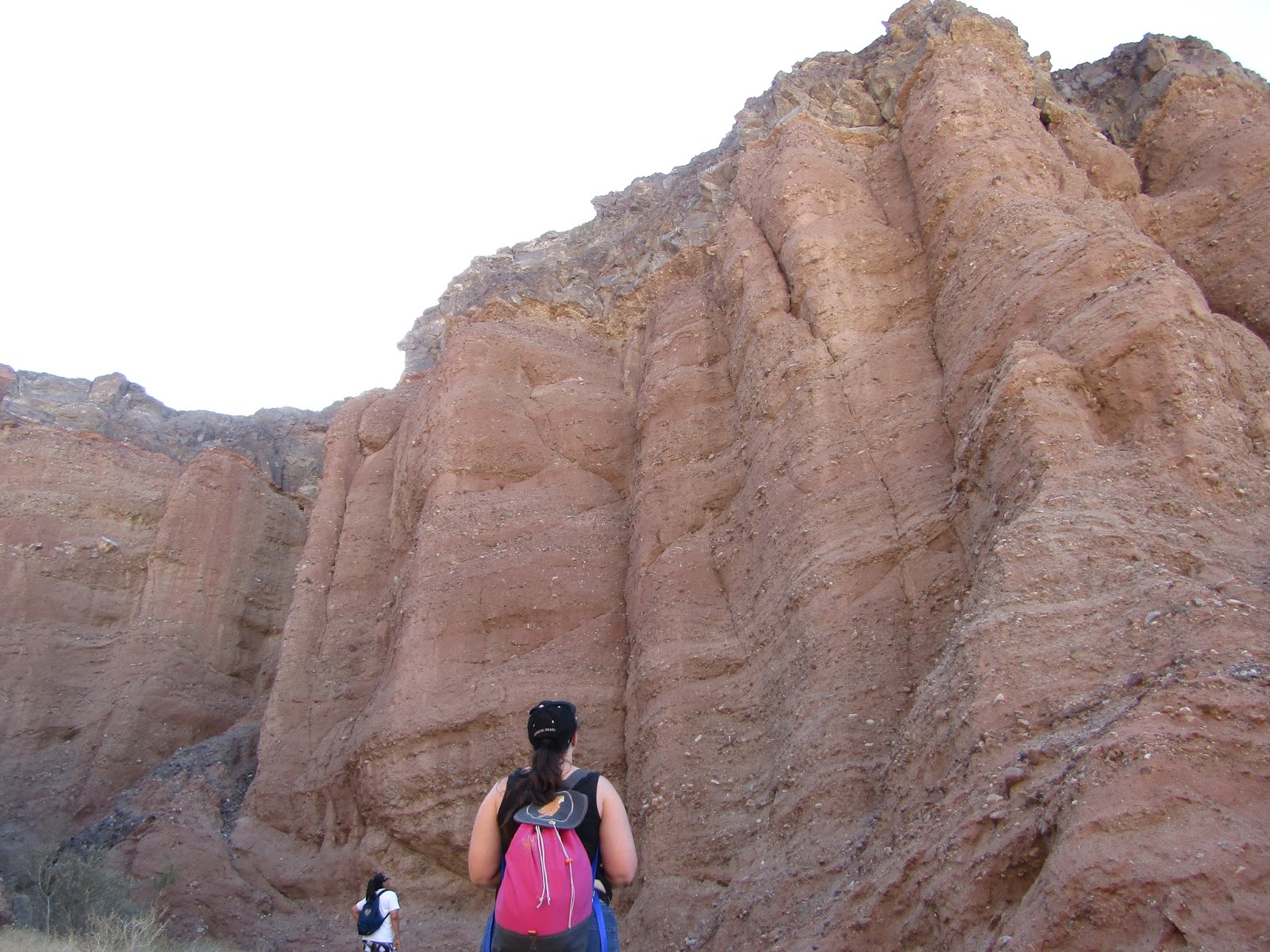
Today, our Education Coordinator, Marcie Rodriguez, took Girl Scout Troop 7030 out on a hike to Fossil Canyon, in the Coyote Mountains. This canyon gives a wonderful geologic perspective on Imperial County. Because of the volcanic activity that existed here 17 million years ago, you can see the layer of black volcanic rock, known as basalt, laying on top of the mountain, rather than below where it usually sits.


The beginning part of the trail is an easy walking trail, one most anyone can do. The girls, and their families, began from a Bureau of Land Management road, and walked into the canyon. From there, they hiked along the inside of

the base of the canyon, till we got to a basalt formation that is a dried waterfall. The girls were adventurous, and decided from there they wanted to try to climb the mountain! They made it almost to the top, before the trail became too rough. After that, they hiked back down to bottom, to have a picnic lunch. Even the lunch was an adventure, as the everyone sat and ate
under a slip strike fault.


Monday, March 16, 2015

A Panoramic View- Volunteers building exhibits

-from the Curator


As we get closer to installing our permanent exhibit we are now developing the media and computer interactive portions. Currently, we are working on the "Land of Extremes" introductory touch screen 360 panoramic interactive.  It will be the primary interactive exhibit that showcases the beauty of the desert and highlights regional destinations for visitors.

It requires the development of a unique program that will run a touchscreen computer, projected onto a 9x12 LCD projection.  The program is being developed by GIGAmacro in Napa, CA.  The company founder is a technology innovator with a passion for developing scientific tools, exhibits, and educational programs that provide ways of exploring the world. He has been very hands-on with our project.


Setting up the Gigapan 360 to share an amazing view


To take the pictures we have to find a great location, set up the camera, and set up the Gigapan 360.  The Gigapan unit shoots the 360 automatically, taking up to 260 images to document a single location.  Staff has been trained to use it, and this week, while out on several hikes, volunteer Bill Pape also learned how to use the program.


Members of the private hiking club Jacumba Hikers, starting their adventure
This Saturday Bill and eight members of the private hiking group Jacumba Hikers hiked about 10 miles through Painted Gorge to Carrizo Peak- the highest point on the Coyote Mountains.  They carried the camera equipment up with them and took several panoramic shots for the exhibit.  It was a hot day, but they saw some beautiful scenery and are looking forward to sharing the view with museum visitors who couldn't make the climb!

Thanks guys for helping build our exhibit!