Showing posts with label ollas. Show all posts

Friday, October 14, 2016

A Timeless Puzzle

-from Edgar Bernal Sevilla, Curation/Education Staff

Edgar Bernal Sevilla examining ceramic sherds from Yuha Desert, IVDM collection 
Today was one of those days that, long after I move on from the Imperial Valley Desert Museum (hopefully a very, very long time from now), I will fondly look back at with a wisp of a smile on my face.  Like when I decided to try my hand at flintknapping, I was itching for something out of the ordinary. The opportunity came when Neal decided figuring out what the desert Kumeyaay were eating in the Yuha Desert was of the utmost importance. And thus, a new adventure began.


Looking at archaeology as a 3-D ceramic puzzle  
To save us all from details that are most likely only interesting to me, we’ll skip to the part when I at long last found the droids- erm . . .- pottery sherds I was looking for. Had I known as a kid I would be putting ancient pottery sherds together like a jigsaw puzzle in order to send them to get chemical analysis, I would’ve sent myself a giant, paradoxical, time-breaking high five. 
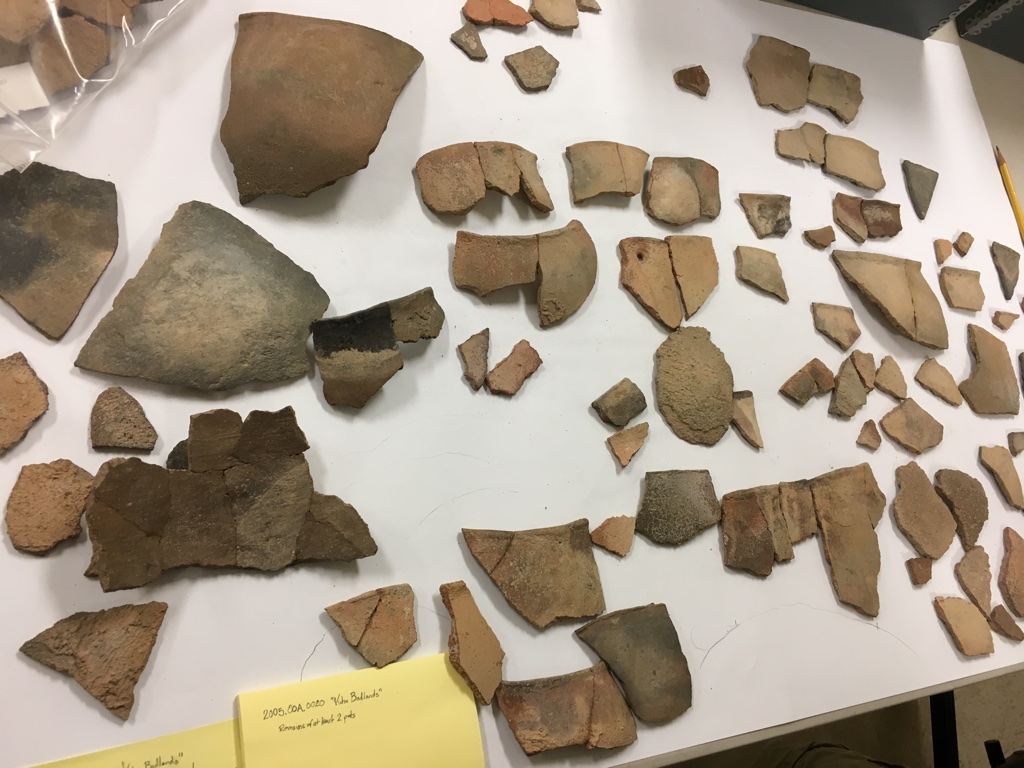


Yuha Desert ceramic sherds, IVDM collection
I spent a few hours moving pieces and figuring out which ones would be the best for analysis. Anne (our head curator and my direct boss); Lindsay Porras, an archaeological researcher currently working on a Master's of Arts in Applied Archaeology from the Department of Anthropology, California State University, San Bernadino, who happened to be in the building doing research on archaeology around the Salton Sea; and I put our brains together and we came up with a criteria for sherds that would be good candidates for chemical analysis- focusing on potsherds that were the bottom of a vessel used for cooking and therefore the most likely to contain traceable food residue.


Piecing together rims to get size of pot
It’s funny that here at the IVDM, I do quite a bit of work that I feel wildly unqualified to do. I often have thoughts of “am I allowed to touch that?” and, perhaps most tellingly, “you’re asking me to do what!?” I often forget that I am now a museum professional with a history degree who has yet to fail in a task I’ve been assigned that my mind tells me I’m wildly unqualified for. Working out here is empowering, and my professional self esteem is frantically trying to catch up to everything I’m learning and my professional competency level. I’m occasionally asked things by other staff members rather than always being the inquirer. I occasionally suggest changes to the museum to my superiors and, to my amazement, they usually agree. And yes Edgar, you ARE allowed to touch those ancient pottery sherds (with curation gloves on, of course.) In fact, you personally were specifically the one asked to do so. And in doing so, I put together a timeless puzzle, taking another step in my journey as a museum professional, and as a confident human being as a whole.

An adventure in archaeology and being a museum professional


Saturday, September 17, 2016

New Olla Comes to IVDM

-from Anne C Morgan, Head Curator

Manfred Knaak, Betsy Knaak, Anne Morgan with new olla
A new olla came to the Imperial Valley Desert Museum today!

The olla, a large ceramic vessel, was brought to the attention of Betsy Knaak, Executive Director of Anza-Borrego Desert Natural History Association, who worked with the donor and the Desert Museum to bring the olla back to the Imperial Valley from Arizona.

This afternoon she and her husband Manfred Knaak, anthropology professor at the Imperial Valley College, delivered the olla to the museum.  The olla was packed in Arizona and no one saw it before it made its journey. The unveiling came when it was unpacked - several visitors were lucky enough to be in the building when the Knaaks arrived and were invited to join. 
Manfred Knaak, Imperial Valley College archaeology professor

Several ollas have come to the museum through families in the last year. Often the ollas were taken out of the desert years ago by someones grandparents. Today, it is not legal to remove artifacts from federal lands. We have been thrilled to work with families to bring the ollas back to where they can be seen by the public.

The new olla will be accessioned into the Museum's collection, carefully photographed, measured, and recorded. Notes will be made of specific features, like the pitch or tar repair along the rim where it was cracked but repaired to continue using.


Copy of original magazine that inspired Larrabee to search for gold
Donated by David Larrabee, the olla had been found by his father Robert over fifty years ago somewhere in the "Borrego Desert".  Robert and his friends, inspired by a magazine article in True West, went in search of gold.  While they never found any, Robert did find this olla, "the only treasure the Borrego Desert was to share with me."  Now, thanks to the generosity of David Larrabee and his family, the olla will be shared with the public in the Museum's Visible Storage exhibit, and may teach researchers something new about the story of people and the desert.


Wednesday, September 7, 2016

Olla Project begins

-from Anne C Morgan, Head Curator

Frank Salazar placing small olla in new, archival, box
Today we began an exciting new project.  Thanks to funds from a National Endowment for the Humanities Preservation Grant, we were able to buy archival supplies that will provide safer, more secure storage for many of the ceramics that are not currently on display in our Visible Storage exhibit.

Angelina Coble "This was so much fun!"
Cultural Collections and Program Manager, Frank J. Salazar III, a member of the Campo Kumeyaay Nation; Head Curator Anne Morgan; and Education staff Angelina Coble spent today building archival boxes, choosing ceramics that would fit the boxes, photographing them, updating their records in our PastPerfect database, and carefully placing them in the new boxes.  Archival, non-reactive foam padding placed inside the boxes will help to pad the ollas, meaning less jostling in the event of an earthquake.  Creating labels with photos on them means less handling of the artifacts, which means they are more secure.  And the ability of the boxes to stack means that storage will become easier, safer, and there will be more room for additional artifact boxes.

While it will take several weeks to complete, this project is a win-win for the museum and the artifacts entrusted in its care!


New boxes means more efficient, safer, storage!

Wednesday, September 9, 2015

Special Guest

-from the Curator


This afternoon the Museum had some special guests come out for a surprise visit:  Leonard Fabian and his daughter Eva. 

 Fabian, who originally found the olla now displayed in the exhibit's Adaptation Case: Water Cache, was thrilled to see the olla in its new permanent home.  "I get emotional every time I come out here" he said "but it brings back such great memories.  It looks so great there."  While Eva has grown up hearing stories about Fabian's experience finding the olla, this was her first time seeing it in person.

In 1977, Leonard Fabian discovered an archaeological site endangered by heavy off-road traffic.  He alerted the Imperial Valley College Desert Museum and the BLM and together they investigated.  The result was the first water cache documented by Imperial Valley archaeologists.

Saturday, May 23, 2015

Ceramics preview Friendraiser

-from the Curator

Tonight we had our last FriendRaiser of our 2014-2015 fiscal year.  With the amount raised tonight we have raised the projected $10,000 from ten FriendRaisers that was our goal for the NEH Challenge grant this year.  Congratulations to our Board Members for all their hard work!

This FriendRaiser focused on ceramics and premiered a short video we have been editing for our permanent exhibit.  A grant from the Alliance for California Traditional Arts allowed us to go through raw footage from the award winning, Emmy nominated documentary First People-Kumeyaay and focus on the footage on ceramics.  Frank Salazar, our Cultural Collections Project Manager edited together from this footage a video of renowned Kumeyaay ceramics artist Teresa Castro going through the steps of making a pot.  A grant from the National Environmental Education Foundation allowed Frank to work with several different Kumeyaay culture bearers and language experts to add Kumeyaay words to the video.  Videos and technology are some of the best ways to reach the younger generations and gain their interest, and have proven successful in other situations.  The hope is that seeing the language embedded in a situation will support "situational fluency" for language learning.

Attendees ate food prepared in ceramic pots, saw both newly made and older ollas that will be in our permanent exhibit, and commented on the video.  Frank is now planning on going back for some more editing to incorporate this great feedback.  We're looking forward to having the final version in our ceramics visible storage exhibit by this fall. Thanks to Conveyor Group for their help in turning these clips into a lovely, smoothly transitioning video.


 Thank you to everyone who attended this and any of the other FriendRaisers this year - you are helping us to drive this museum forward to success!


Thursday, October 9, 2014

Fabian's Visit

Lennie Fabian stopped in today to see the ceramic vessel that bears his name. The Fabian Olla, as it is now known, was the first cached vessel excavated by Imperial County archaeologists back in 1977, and will be featured in the new permanent exhibit.

Finding the vessel and informing the local authorities, allowing them to properly document the location and condition of the artifact, sent Fabian's life careening into a direction he never imagined. He now lives in Guatemala with his wife, whom he met as a direct result of his local notoriety.  It was wonderful to see these two old friends re-unite and to show Mr. Fabian the designs for the new display, currently under fabrication by the Museum's design team at WE Exhibits.


Friday, September 19, 2014

Fun with Ceramics: an Evening with an Expert- Dr. Suzanne Griset

-Anne C. Morgan, Head Curator

Dr. Suzanne Griset explores the Museum ceramics collection with members
On Saturday we had the pleasure of having Dr. Suzanne Griset join us for a day of fun with ceramics.  Suzanne, the principle investigator and project manager with SWCA, is an expert on the ceramics of Southern California.  She was kind enough to work with us during the day, answering questions we had about clay in general and pieces of our collection in particular.   She also joined us for a Members-only Evening with an Expert and gave a presentation to 23 Museum members who wanted to learn more about our collection.

As we work to prepare our collection of ollas for display in the new permanent exhibit (opening Spring 2015) her insight was incredibly helpful.

We learned some fascinating ceramic facts from Dr. Griset:

This jar bottom became a bowl after breaking
  • Pottery probably came to the San Diego area by about 900 CE (Common Era), and made it to the Imperial Valley by 1000  
  • Handles are not seen on vessels in Southern California before Spanish Contact in 1540
  • Cracks in vessels can be repaired by drilling small holes on either side of the crack and lacing together with yucca fiber or sinew
  • Water jars have a life span of about 2 years where they will keep water cool.  After 2 years salts penetrate the clay and it no longer cools water.  They can be reused as something else, like cooking pots 
  • Stucco on pots lowers the thermal fracturing of clay- which makes it ideal for cooking pots that are in and out of the fire frequently!
  • After 1880 the railroad brought new people to the Southwest.  Tribes began selling pottery to the tourists and copying styles that sold well.  The forms and designs of the Maricopa peoples became particularly popular

Maricopa style ceramic frog


Want to learn more about ceramics?  Look for our Land of Extremes article in tomorrow's Imperial Valley Press!


Dr. Suzanne Griset with a few of the pots you'll see in our permanent exhibit-Spring 2015!