Showing posts with label exhibit building. Show all posts

Thursday, July 21, 2016

Roadrunners & Research

-Anne C. Morgan, Head Curator

 Months of talking to museum visitors as we do strategic planning have shown that developing outdoor landscaping is one of the more popular future plans.  People are excited to continue learning more about the local plants and animals, and understanding the amazing natural world around them.

But what form will that take? The possibilities are endless, but we know people are hoping for easy walking trails, desert art through the Rainforest Art Project, and interpretive signs over the next five years or so.  All of these ideas have to start somewhere, and they are starting now!
Meet our local Greater Roadrunner, the inspiration behind these test panels!
Recently a roadrunner moved into the neighborhood and has become a regular museum visitor.  He's become very popular on our Facebook page and became the inspiration for the initial outdoor exhibit testing we're currently doing.  We know we want interpretive signs about native plants along our future trails to help people identify them, but what do our visitors want to know about the animals that live here?
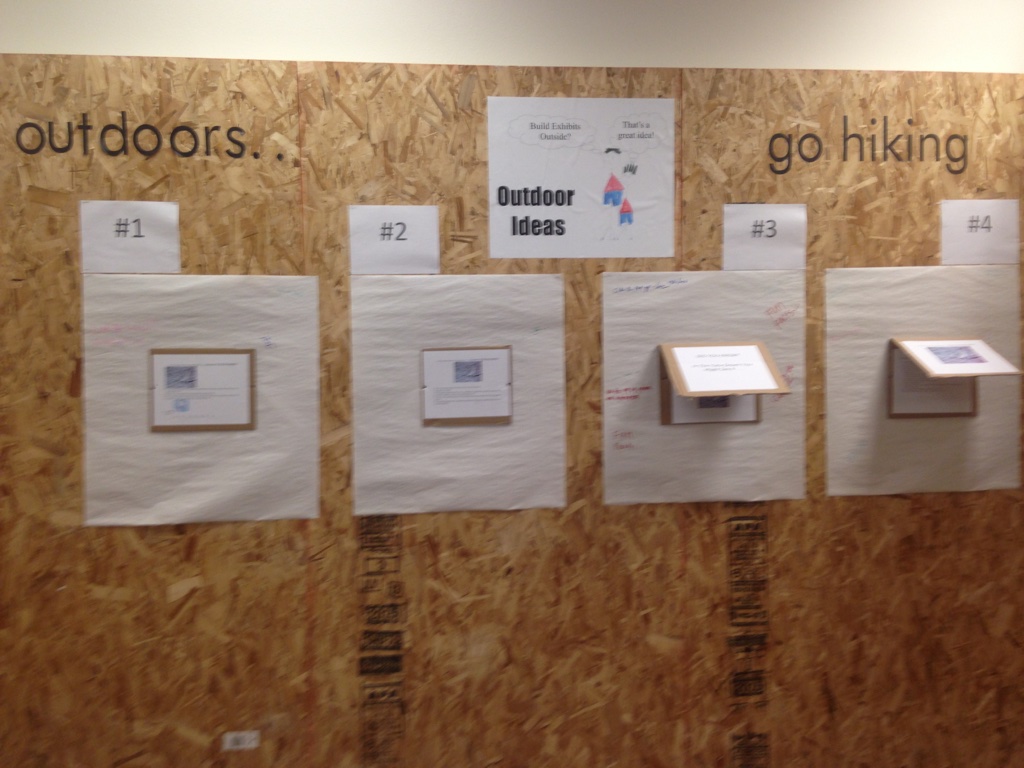
4 different ideas to start discussing outdoor signage
A little roadrunner research has led to 4 different sign ideas.  Visitors coming out to the museum now can look at 4 different signs and decide what it is they like about each one, and what do they want to see that is missing? Do people want a map of an animal's range in North America?  What their tracks look like?  Fun factoids or just the basic facts? Single panels or ones you have to flip open?
Should panels include identifying animal tracks?
These signs have only been up about a week and we're already learning a lot! So far everyone loves the idea of identifying animal tracks.  But people are split down the middle on liking single panels and flip panels, and on flip panels that have a picture of the animal on the outside vs having to open the panel and discover what it's talking about.

Flip sign version one: open to discover what animal it's talking about
Flip sign version 2: see the animal before opening
Flip signs offer more space for info, when it it too much?

The feedback we get on the current ideas will help as we work with graphic designers and exhibit builders in the future to create outdoor exhibits that meet as many visitor expectations and interests as possible.

Wednesday, September 9, 2015

Special Guest

-from the Curator


This afternoon the Museum had some special guests come out for a surprise visit:  Leonard Fabian and his daughter Eva. 

 Fabian, who originally found the olla now displayed in the exhibit's Adaptation Case: Water Cache, was thrilled to see the olla in its new permanent home.  "I get emotional every time I come out here" he said "but it brings back such great memories.  It looks so great there."  While Eva has grown up hearing stories about Fabian's experience finding the olla, this was her first time seeing it in person.

In 1977, Leonard Fabian discovered an archaeological site endangered by heavy off-road traffic.  He alerted the Imperial Valley College Desert Museum and the BLM and together they investigated.  The result was the first water cache documented by Imperial Valley archaeologists.

Sunday, August 30, 2015

Exhibit work continues

-from the Curator

Measuring pieces for trays
The installers from Weldon Exhibits may have left, but there are behind the scene aspects of exhibit building that continue.  Today, we worked on building the trays that will hold the glass bead base of our visible storage exhibit and added some finishing touches of paint and rust effects to wood. It's amazing to see the difference a few little touches makes!

 We were also inspired by the beautifully clear weather to drive out and re-take our panoramic images of the Yuha Desert for the Land of Extremes.  

A photographer's work is never done

Secret superhero photographer?

Saturday, April 18, 2015

Frequently asked question: When will you open?

-from the Director

Archaeology section- under development
"When will you open?" is a question we have been getting a lot lately. Currently, we are installing the casework for Phase I and Phase 2 of our exhibit. This will take 3 weeks.  Though this is a lot like installing furniture, it is big furniture, and just like at your house, it also requires a lot of painting and wallpapering.  After installation, museum staff will have three weeks to complete painting, put back ceilings, and do a deep cleaning.

After the rocks and casework are installed and the museum is cleaned up, we will be installing interactives, media, and software. This entails setting up computers and LCD projectors and requires three more weeks to make sure everything is installed properly and running correctly.  After all this, we will prepare artifacts for mounting and installation. This is the most complicated and time consuming step that museum staff will be doing. This will take most of the summer.

Painting and protecting rocks
A Borrego Sheep & mountain lion in the new exhibit

Phase 3 of the exhibit will cover the geology of Imperial Valley, and we are hoping that there will be public support to finish our exhibit sooner rather than later. If this is the case, we will complete the final design for Phase 3 in the fall and install these components this winter. This would allow us to have an official "grand opening" in the spring of next year.

Until then, we are planning a series of rolling soft openings for our members and a few for the public as exhibit software is tested and comes fully online or as artifacts get installed in specific cases.

We are not taking the traditional approach to opening a new museum where visitors don't see anything until a grand unveiling. We have had people come in the building throughout the process and many have seen the behind-the-scenes process that goes into building a permanent museum exhibit.  We want our visitors to feel involved every step of the way, and feel pride and ownership in a museum that they have watched grow into something truly special.

This excerpt is from "Land of Extremes: Desert Museum: Behind the scenes of new exhibit." by Neal V. Hitch. Imperial Valley Press. April 18, 2015. For the full article, see today's Imperial Valley Press.

Wednesday, April 15, 2015

Water is Life Leak widescreen 30 sec


From the Director:


Today, the installation team from Weldon Exhibits began installing the media and interactive components of the Land of Extremes exhibit. The Habitats in Flux exhibit will be an area where we show six desert animals or habitats that are changing. It includes 30 seconds of video of the ocean (there is a reason you find oyster beds in the Yuha Desert), 30 seconds of big horn sheep, and we just now finished the 30 seconds of clips edited from the trail camera that we have had out on one of our leaky faucets.


We are still waiting to get video on the Condor, the flat-tailed horned lizard, and burrowing owl. With all the work going on in the Valley with the Burrowing owl you would think it would be easy to get video, but not yet.


You will have to wait until after May to see the completed Habitats in Flux interactive, but you can see the first video right now.

Friday, April 3, 2015

Exhibit Installation has Begun

-from the Curator
Looking good, even in protective wrap!
Monday, March 30 and Tuesday, March 31 trucks arrived and members of the Weldon Exhibits team spent an intense two days unloading exhibit components.  Wednesday began installation and even at the start of Day 3 you can already see the exhibits starting to take shape. 

Unloading components
Before installation
  
It's thrilling to see what we've only imagined through design drawings starting to take shape in our museum- we hope you're getting as excited as we are!
WE staff applying photographic mural

Our sheep will supervise the rest of installation 


Monday, March 16, 2015

A Panoramic View- Volunteers building exhibits

-from the Curator


As we get closer to installing our permanent exhibit we are now developing the media and computer interactive portions. Currently, we are working on the "Land of Extremes" introductory touch screen 360 panoramic interactive.  It will be the primary interactive exhibit that showcases the beauty of the desert and highlights regional destinations for visitors.

It requires the development of a unique program that will run a touchscreen computer, projected onto a 9x12 LCD projection.  The program is being developed by GIGAmacro in Napa, CA.  The company founder is a technology innovator with a passion for developing scientific tools, exhibits, and educational programs that provide ways of exploring the world. He has been very hands-on with our project.


Setting up the Gigapan 360 to share an amazing view


To take the pictures we have to find a great location, set up the camera, and set up the Gigapan 360.  The Gigapan unit shoots the 360 automatically, taking up to 260 images to document a single location.  Staff has been trained to use it, and this week, while out on several hikes, volunteer Bill Pape also learned how to use the program.


Members of the private hiking club Jacumba Hikers, starting their adventure
This Saturday Bill and eight members of the private hiking group Jacumba Hikers hiked about 10 miles through Painted Gorge to Carrizo Peak- the highest point on the Coyote Mountains.  They carried the camera equipment up with them and took several panoramic shots for the exhibit.  It was a hot day, but they saw some beautiful scenery and are looking forward to sharing the view with museum visitors who couldn't make the climb!

Thanks guys for helping build our exhibit!


Monday, January 26, 2015

Exhibit Text

For the last year, we have been working with Dean Weldon Exhibits to design and fabricate a permanent exhibit at the Imperial Valley Desert Museum. Today, we reviewed the final text panels for the first printing.

For six months we have been writing exhibit text. We have gone through prototyping and visitor evaluations. We had different groups of people come out the the museum and read the text out loud as fast as they could. This was to see how things read, and in fact this caught lots of issues.

On a panel about using natural materials as pigments for decorating ceramics 5 out of 6 readers read the word "plant" for the word "paint." This got corrected.

But today was about a final reading. Changing a "to" to a "for." Finding a sentence that used the word "might" twice.

I love the big ideas and the dreams. Now we are down to the details, and in a day or two we will be in print.

Thursday, October 9, 2014

Fabian's Visit

Lennie Fabian stopped in today to see the ceramic vessel that bears his name. The Fabian Olla, as it is now known, was the first cached vessel excavated by Imperial County archaeologists back in 1977, and will be featured in the new permanent exhibit.

Finding the vessel and informing the local authorities, allowing them to properly document the location and condition of the artifact, sent Fabian's life careening into a direction he never imagined. He now lives in Guatemala with his wife, whom he met as a direct result of his local notoriety.  It was wonderful to see these two old friends re-unite and to show Mr. Fabian the designs for the new display, currently under fabrication by the Museum's design team at WE Exhibits.