Showing posts with label outdoor exhibits. Show all posts

Sunday, September 4, 2016

Celebrating and Interpreting the Desert

-from the Director

Current outdoor trails in the front of the museum lead to picnic benches
Our visitors want to learn about the desert. This has been made clear by the last several months we have been collecting information from visitors and members in preparation for completing a new five-year Strategic Plan.  In July, we acquired and protected two new parcels of land adjacent to the museum through a grant from the Protect Our Communities Foundation. The new properties will allow us to develop outdoor programming in the future, and part of the Museum’s long-term plan must now look at addressing questions and opportunities outside of the museum.


The Great Outdoors
The Desert Museum has a mission to preserve, celebrate, and interpret the desert.  Celebrating and interpreting the desert can take many forms. We are just beginning to think about outdoor exhibits and displays around the museum. Touchable displays, guided nature walks, and informational signs are all methods of enriching the visitor experience by highlighting the importance of what people experience outside of the museum – in the actual desert.  Outdoor exhibits are meant to make people think about their experience, and to make new connections between the information they learn and their previous perceptions.  We do not know what our exterior exhibits will look like, but with the protection of the property surrounding museum we can now start thinking about it. 
Future trails will allow visitors to explore the desert with outdoor art, seating areas, and signage

Outside, Inside
As the Desert Museum begins the interpretive planning process that will lead to outdoor trails and exhibits, the main question is: what do visitors want?  What interests them?  How do they want to have information presented to them? 

In 2013 and 2014, we spent many months testing and developing interior exhibits.  The results of that work can now be seen in the new permanent exhibit Land of Extremes. This week we began testing some early sign ideas for exterior exhibits. This work will continue throughout the next year and we are hoping that many of our friends and members will come out and participate in this exciting phase of exhibit development.

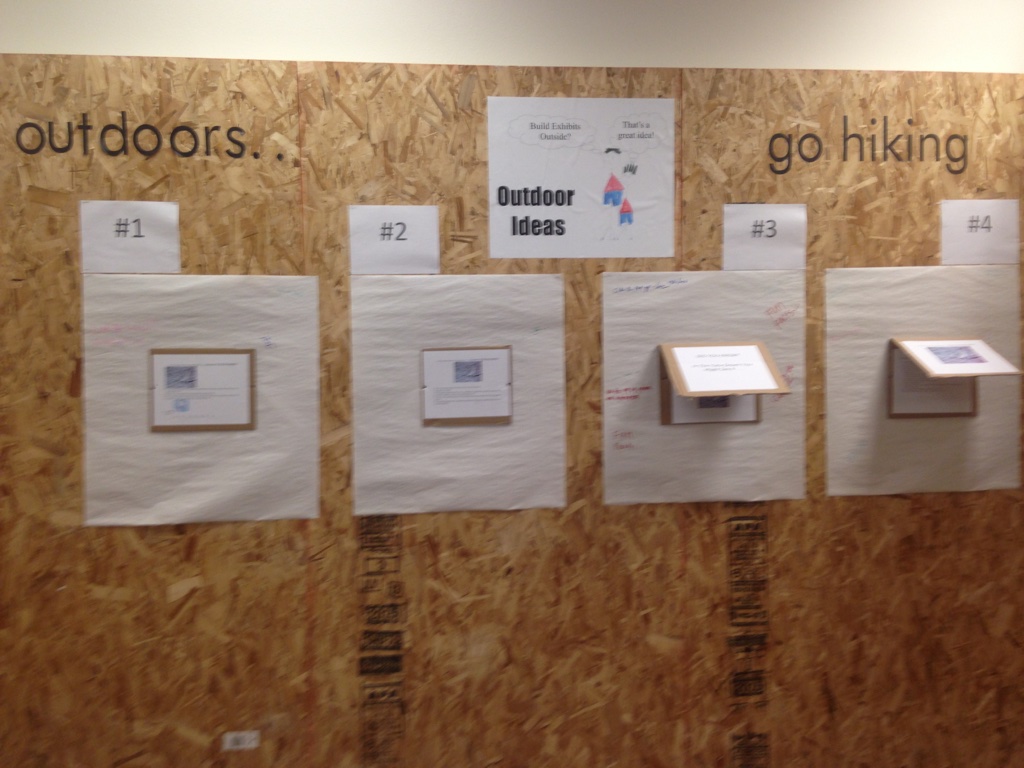
4 versions of a sign on roadrunners encourage visitors to think about what they want in outdoor signage
Testing
Young visitor Lexi Romo writes down what she likes best about a sign
What kind of signs will interest people in the animals of our desert?  The staff was inspired by a roadrunner, a regular museum visitor, to start testing ideas and getting a feel for the kind of information visitors want about local animals.  Visitors coming out to the museum can, for the next few weeks, look at four different test signs and decide what they like and what they want to see that is currently missing.  Do people want a map of the animal’s habitat?  What their tracks look like? Fun factoids or just basic facts?  Single panels or ones you have to flip open?

The current signs have been up for a week and already the staff has learned a lot.  So far visitors have all loved the idea of signs that include identifying the animal’s tracks.  But people have been split on preferring single panel signs and flip signs.  Those that like the flip signs are split on the idea of whether the first panel should be a picture of the animal or a more teasing “You Might See A . . . “ that extends visitor interaction by forcing you to open the panel to see what animal it is talking about. 

Visitor feedback on these early ideas will be the basis of conversations as the museum works with graphic designers and exhibit builders to create future outdoor exhibits that meet as many visitor expectations and interests as possible. 

Roadrunners
A visiting roadrunner inspired the newest test panels in the museum
Each one of the test signs contains similar basic information on the Greater Roadrunner.  For example:
·      Diet: Lizards, snakes, insects, mice, scorpions, seeds, fruit
·      Predators: Hawks, owls, cats
·      Size: 24 inches long from beak to tail.  10-12 inches high
·      Tracks: The unique shape of a roadrunner’s foot leave a single-file line of X shaped tracks

Because of the additional space available on flip signs, more information can be added.  Is there a point where people get bored by too many words?  Or are you still interested to read:
  • ·      Roadrunners can run almost 20 miles an hour.  Fanning their wings and tail lets them stop suddenly and turn on a dime
  • ·      They make a range of sounds from clicks and coos to beak clacking


What about fun facts like:
  • ·      The Greater Roadrunner’s scientific name Geococcyx californicus means “ground dwelling cuckoo”
  • ·      Roadrunners are in the same family as the cuckoo bird because they share a similar zygodactyl foot shape
  • ·      A group of roadrunners is called a “marathon” or a “race”


This article can also be seen in Saturday, September 3, 2016 Imperial Valley Press. IVDM's Land of Extremes series.


Saturday, August 20, 2016

Conserving Desert Land

-from Anne C Morgan, Head Curator


Education staff member Angelina Coble talks about drought resistant plants
in the Hector Sanchez Eagle Scout garden
    
Our visitors want to learn about the desert. This has been made clear over the last several months as we have been collecting information from visitors and members in preparation for completing a new five-year Strategic Plan.  We have piloted field trips hiking around our property. The one Eagle Scout garden that was planted in 2014 is beginning to look amazing.  We have just been asked to give a desert hiking experience to a group of educators who don't really want to go that far into the desert. Though we have not quite completed all phases of the interior exhibits, part of the Museum’s long-term plan must now look at addressing questions and opportunities outside of the museum as well.

Preserving the Desert
Last year, the Desert Museum and the Kumeyaay Diegueno Land Conservancy collaborated on a project to protect 15 acres of vacant desert land near the museum. The Kumeyaay people have the most diverse traditional landscape of any people in the Americas: going from the Pacific coast, through the mountains, to the lakeshore, the desert, and into Baja California.  The partnership between IVDM and KDLC created a mechanism where desert land could be purchased, protected, and used for museum and education programs.

New properties will be used for museum and education programs    
In July, the Desert Museum received a grant from the ProtectOur Communities Foundation to buy and protect two additional parcels of land directly adjacent to the museum parking lot.  The grant of $140,000 allowed the museum to acquire the parcels, and working with the KDLC, conservation easements will ensure that these properties will forever be used for museum and education programs.   

For years the museum has been surrounded by vacant desert land. The museum was built to be a low-impact building within this environment. Driving past the museum on Interstate 8 the surrounding desert land is striking, but it was never protected. Now it is. 

Part of the Museum’s mission is to preserve desert lands. Part of that mission is also to celebrate and educate people about the desert. Visitor feedback has shown that people are unanimously interested in seeing the museum expand its exhibits to the outdoors.  Acquiring and preserving the properties around us will allow us to develop programs for the public, interpret the importance of our drought resistant desert plants, and allow access to the beauty of the desert biome.     

The Great Outdoors

6th graders from Sunflower Elementary hike on museum lands in the 2015 school season    
Many people who come to the Desert Museum for the first time come in thinking that the desert is boring.  “There’s nothing there” is a common statement.  Our interior exhibits are designed to make people think about what they see when they are outside, and to understand what they are seeing. The Rock Talk pullouts and the Land of Extremes panoramas were created to give visitors a new view of the land.  We hope that making connections like this will make more people interested in going out on hikes and putting that knowledge into practice. With the protection of the properties near the museum, we will now have the ability to get people directly out into a desert environment. This is a game changer.

Partners and Friends
We have been working on protecting all of the property around the museum for more than a year. This could never have happened without the help of our friends and partners. 

Our partnership with the Kumeyaay Diegueno Land Conservancy has been a huge success. The KDLC is an organization that has benefitted from the support from nine of the twelve Kumeyaay Bands in the United States. They are a nonprofit organization dedicated to preserving and protecting environmentally and culturally sensitive lands within the traditional Kumeyaay territory.  The museum is hoping that the partnership will be long-term and will result in some great projects.

Mary Anne Zimmerman, Attorney-at-law, was indispensable in creating a draft conservation easement. She has been a long-time member and supporter of the museum. At a critical time, she was able to provide council and a direction that proved successful.

The grant process with the Protect Our Communities Foundation began in October 2015. We appreciate their communication and diligence at following through with our proposals. In the end, we achieved even more than we had expected when we applied for their grant. Their aid in protecting vacant desert land around the museum will benefit the education of generations of students in Imperial County. 

Thursday, July 21, 2016

Roadrunners & Research

-Anne C. Morgan, Head Curator

 Months of talking to museum visitors as we do strategic planning have shown that developing outdoor landscaping is one of the more popular future plans.  People are excited to continue learning more about the local plants and animals, and understanding the amazing natural world around them.

But what form will that take? The possibilities are endless, but we know people are hoping for easy walking trails, desert art through the Rainforest Art Project, and interpretive signs over the next five years or so.  All of these ideas have to start somewhere, and they are starting now!
Meet our local Greater Roadrunner, the inspiration behind these test panels!
Recently a roadrunner moved into the neighborhood and has become a regular museum visitor.  He's become very popular on our Facebook page and became the inspiration for the initial outdoor exhibit testing we're currently doing.  We know we want interpretive signs about native plants along our future trails to help people identify them, but what do our visitors want to know about the animals that live here?
4 different ideas to start discussing outdoor signage
A little roadrunner research has led to 4 different sign ideas.  Visitors coming out to the museum now can look at 4 different signs and decide what it is they like about each one, and what do they want to see that is missing? Do people want a map of an animal's range in North America?  What their tracks look like?  Fun factoids or just the basic facts? Single panels or ones you have to flip open?
Should panels include identifying animal tracks?
These signs have only been up about a week and we're already learning a lot! So far everyone loves the idea of identifying animal tracks.  But people are split down the middle on liking single panels and flip panels, and on flip panels that have a picture of the animal on the outside vs having to open the panel and discover what it's talking about.

Flip sign version one: open to discover what animal it's talking about
Flip sign version 2: see the animal before opening
Flip signs offer more space for info, when it it too much?

The feedback we get on the current ideas will help as we work with graphic designers and exhibit builders in the future to create outdoor exhibits that meet as many visitor expectations and interests as possible.