Showing posts with label exhibit testing. Show all posts

Saturday, August 13, 2016

Summer and Water

-from the Head Curator

'Dig deeper' into Lake Cahuilla with the touchscreen
Though summer is a slow time in the Valley, visitors still come out to the museum.  Today we had a family of 7 so interested in the story of water in the Imperial Valley that they stayed for over an hour! They explored our topographic Lake Cahuilla map, including each of the 'dig deeper' images that can be pulled up to learn more about what life was like at different time periods around the lake. The drawing of the megaladon was the definite favorite for the kids!


They watched the entire 18 minute video Early History of Water in Imperial County by Brian McNeese and the Imperial Irrigation District. "I didn't know that!" was heard a lot!


Summer is a time to test out ideas and get feedback, and this family was nice enough to look at our Roadrunner test panels and tell us what they liked best.  Surprisingly, it was the scientific name: Geococcyx californianus!
Testing information panels to see what people like

Thursday, July 21, 2016

Roadrunners & Research

-Anne C. Morgan, Head Curator

 Months of talking to museum visitors as we do strategic planning have shown that developing outdoor landscaping is one of the more popular future plans.  People are excited to continue learning more about the local plants and animals, and understanding the amazing natural world around them.

But what form will that take? The possibilities are endless, but we know people are hoping for easy walking trails, desert art through the Rainforest Art Project, and interpretive signs over the next five years or so.  All of these ideas have to start somewhere, and they are starting now!
Meet our local Greater Roadrunner, the inspiration behind these test panels!
Recently a roadrunner moved into the neighborhood and has become a regular museum visitor.  He's become very popular on our Facebook page and became the inspiration for the initial outdoor exhibit testing we're currently doing.  We know we want interpretive signs about native plants along our future trails to help people identify them, but what do our visitors want to know about the animals that live here?
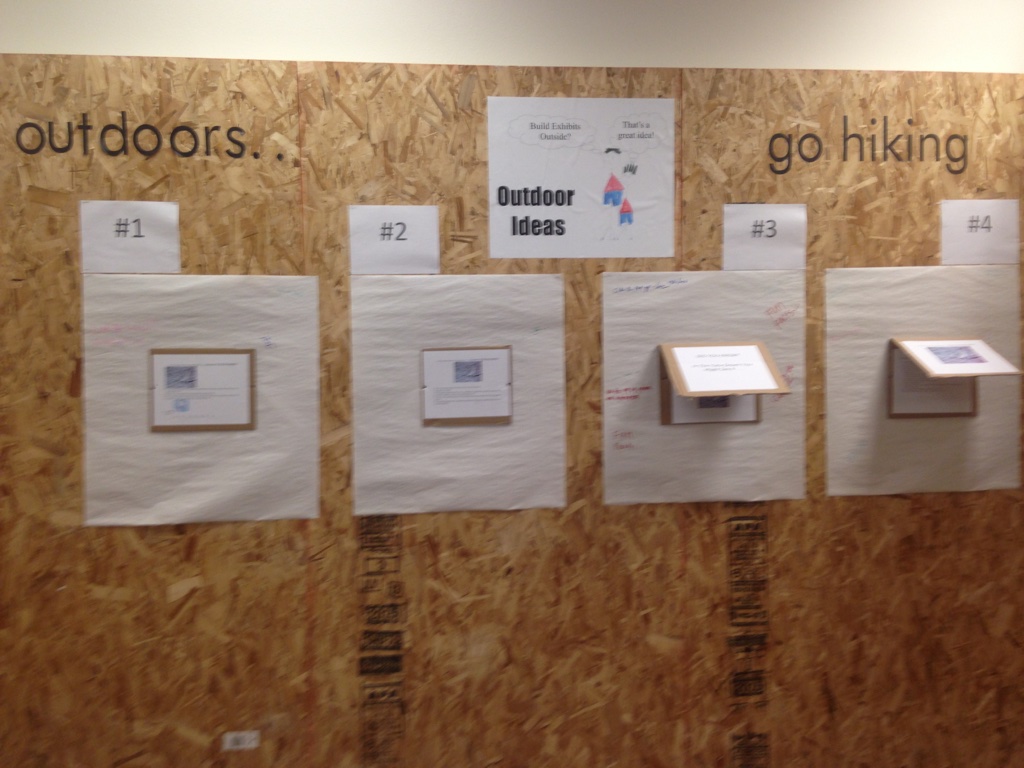
4 different ideas to start discussing outdoor signage
A little roadrunner research has led to 4 different sign ideas.  Visitors coming out to the museum now can look at 4 different signs and decide what it is they like about each one, and what do they want to see that is missing? Do people want a map of an animal's range in North America?  What their tracks look like?  Fun factoids or just the basic facts? Single panels or ones you have to flip open?
Should panels include identifying animal tracks?
These signs have only been up about a week and we're already learning a lot! So far everyone loves the idea of identifying animal tracks.  But people are split down the middle on liking single panels and flip panels, and on flip panels that have a picture of the animal on the outside vs having to open the panel and discover what it's talking about.

Flip sign version one: open to discover what animal it's talking about
Flip sign version 2: see the animal before opening
Flip signs offer more space for info, when it it too much?

The feedback we get on the current ideas will help as we work with graphic designers and exhibit builders in the future to create outdoor exhibits that meet as many visitor expectations and interests as possible.

Saturday, April 25, 2015

Member Friendraiser: Testing interactives

-from the Curator

First visitors at the 'Water is Life' topo map

Today a group of visitors attended a Friendraiser hosted by Board Member Lisa Gallinat at the Museum.  Friendraisers are designed as small, intimate events where attendees explore a behind the scenes aspect of the museum or lecture while raising money for the Museum's Endowment fund. Thanks to a grant from the National Endowment for the Humanities, the donations given for this event are matched by the NEH.

Discovering a mountain lion


Today our event visitors were the first to see two new interactive exhibits as part of the installation of the Museum's new permanent exhibit.  At the "Land of Extremes" visitors were introduced to panoramic images of the valley projected onto a screen. Using a touchscreen they experimented with zooming in to close up images, using icons to explore the desert and hiking destinations.  The second new interactive, "Water is Life" is a topographic map that projects images of the ocean and Lake Cahuilla as it fills and recedes in the Imperial Valley. A touchscreen allows visitors to see different animals that would have been present at different times in the Valley's history.
Although they will not yet be on every day, over the next several weeks we will be testing these interactives, working out the bugs in the systems, seeing how people use them, and how long they stay at the different stations.
Exploring the 'Land of Extremes'


Exploring the changing water projections of Lake Cahuilla


Monday, January 26, 2015

Exhibit Text

For the last year, we have been working with Dean Weldon Exhibits to design and fabricate a permanent exhibit at the Imperial Valley Desert Museum. Today, we reviewed the final text panels for the first printing.

For six months we have been writing exhibit text. We have gone through prototyping and visitor evaluations. We had different groups of people come out the the museum and read the text out loud as fast as they could. This was to see how things read, and in fact this caught lots of issues.

On a panel about using natural materials as pigments for decorating ceramics 5 out of 6 readers read the word "plant" for the word "paint." This got corrected.

But today was about a final reading. Changing a "to" to a "for." Finding a sentence that used the word "might" twice.

I love the big ideas and the dreams. Now we are down to the details, and in a day or two we will be in print.