-from the Head Curator
Sometimes you want to know what's going on somewhere, but you don't feel like reading about it. Wouldn't it be easier if you could just watch something fun?
Now, in addition to keeping up with us on this blog, Facebook, Twitter, and Instagram, we're going to do video blogs (vlogs)! Every 2 weeks or so expect to find a fun, short video on our IVDM YouTube channel showing you something happening at the museum. Don't normally follow YouTube? Don't worry! We'll post the video links on Facebook and Twitter so you never miss one!
We hope you enjoy the videos, and let us know what you think of these casual, fun, maybe quirky, hopefully still informative little videos! After all, don't you want to see What's Up Wednesday!
Wednesday, August 17, 2016

Saturday, August 13, 2016
Summer and Water
-from the Head Curator
Though summer is a slow time in the Valley, visitors still come out to the museum. Today we had a family of 7 so interested in the story of water in the Imperial Valley that they stayed for over an hour! They explored our topographic Lake Cahuilla map, including each of the 'dig deeper' images that can be pulled up to learn more about what life was like at different time periods around the lake. The drawing of the megaladon was the definite favorite for the kids!
They watched the entire 18 minute video Early History of Water in Imperial County by Brian McNeese and the Imperial Irrigation District. "I didn't know that!" was heard a lot!
Summer is a time to test out ideas and get feedback, and this family was nice enough to look at our Roadrunner test panels and tell us what they liked best. Surprisingly, it was the scientific name: Geococcyx californianus!
 |
| 'Dig deeper' into Lake Cahuilla with the touchscreen |

They watched the entire 18 minute video Early History of Water in Imperial County by Brian McNeese and the Imperial Irrigation District. "I didn't know that!" was heard a lot!
Summer is a time to test out ideas and get feedback, and this family was nice enough to look at our Roadrunner test panels and tell us what they liked best. Surprisingly, it was the scientific name: Geococcyx californianus!
 |
| Testing information panels to see what people like |
Thursday, July 21, 2016
Roadrunners & Research
-Anne C. Morgan, Head Curator
Months of talking to museum visitors as we do strategic planning have shown that developing outdoor landscaping is one of the more popular future plans. People are excited to continue learning more about the local plants and animals, and understanding the amazing natural world around them.
But what form will that take? The possibilities are endless, but we know people are hoping for easy walking trails, desert art through the Rainforest Art Project, and interpretive signs over the next five years or so. All of these ideas have to start somewhere, and they are starting now!
Recently a roadrunner moved into the neighborhood and has become a regular museum visitor. He's become very popular on our Facebook page and became the inspiration for the initial outdoor exhibit testing we're currently doing. We know we want interpretive signs about native plants along our future trails to help people identify them, but what do our visitors want to know about the animals that live here?
A little roadrunner research has led to 4 different sign ideas. Visitors coming out to the museum now can look at 4 different signs and decide what it is they like about each one, and what do they want to see that is missing? Do people want a map of an animal's range in North America? What their tracks look like? Fun factoids or just the basic facts? Single panels or ones you have to flip open?
These signs have only been up about a week and we're already learning a lot! So far everyone loves the idea of identifying animal tracks. But people are split down the middle on liking single panels and flip panels, and on flip panels that have a picture of the animal on the outside vs having to open the panel and discover what it's talking about.
The feedback we get on the current ideas will help as we work with graphic designers and exhibit builders in the future to create outdoor exhibits that meet as many visitor expectations and interests as possible.
Months of talking to museum visitors as we do strategic planning have shown that developing outdoor landscaping is one of the more popular future plans. People are excited to continue learning more about the local plants and animals, and understanding the amazing natural world around them.
But what form will that take? The possibilities are endless, but we know people are hoping for easy walking trails, desert art through the Rainforest Art Project, and interpretive signs over the next five years or so. All of these ideas have to start somewhere, and they are starting now!
 |
| Meet our local Greater Roadrunner, the inspiration behind these test panels! |
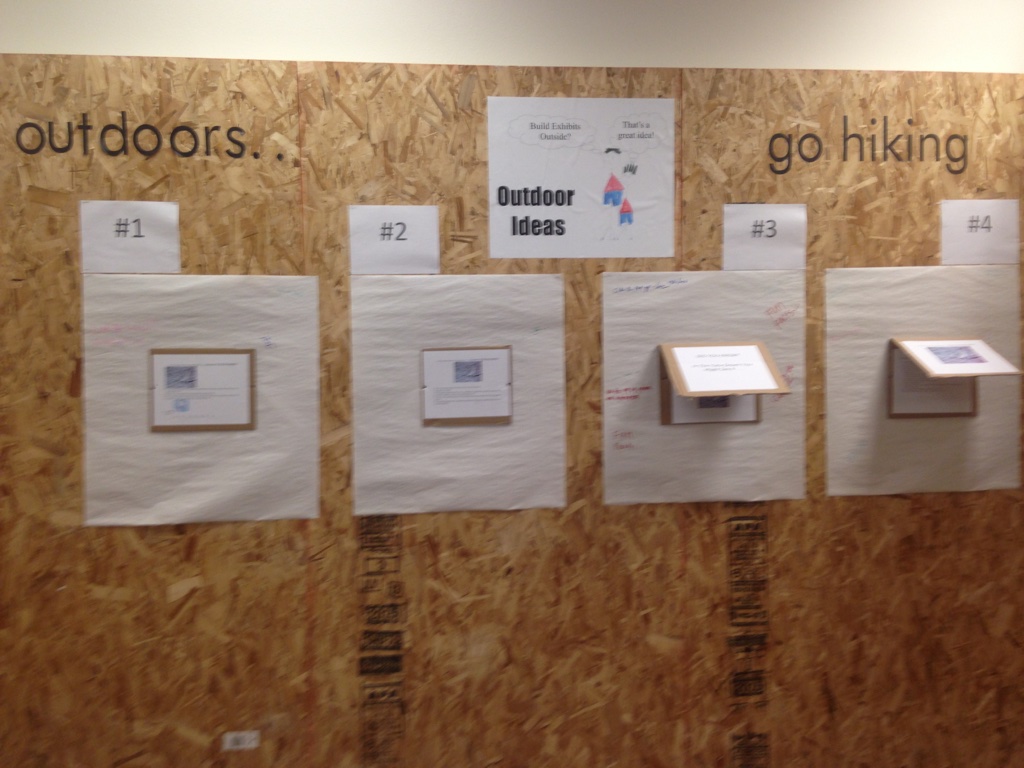 |
| 4 different ideas to start discussing outdoor signage |
 |
| Should panels include identifying animal tracks? |
 |
| Flip sign version one: open to discover what animal it's talking about |
 |
| Flip sign version 2: see the animal before opening |
 |
| Flip signs offer more space for info, when it it too much? |
The feedback we get on the current ideas will help as we work with graphic designers and exhibit builders in the future to create outdoor exhibits that meet as many visitor expectations and interests as possible.
Friday, June 24, 2016
Endowment Challenge
-from Anne C Morgan, Head Curator
July marks the end of our fiscal year and the end of Year 2 of our National Endowment of Humanities Challenge Grant. Through the Challenge Grant the NEH will match 3:1 any money we raise towards our Endowment Fund through 2019.

The Museum's goal is to raise $1 million by 2019 towards the Endowment. When this goal is reached, the IVDM's Endowment Fund will fund two permanent, professional staff positions.
Want to donate to the Endowment but can't afford the whole amount now? We are also doing Pledge Cards. People can pledge to donate this year and the pledge will go towards this year's match by the NEH. Since April we have already raised $10,000 in pledges from museum supporters!
Last year in our last fiscal month, our members and supporters raised $22,000 to help us reach our goal of $195,000! It was a huge success! Can we do as well this year? Please consider supporting the museum by donating or pledging to the Endowment Fund before July 20, 2016.

July marks the end of our fiscal year and the end of Year 2 of our National Endowment of Humanities Challenge Grant. Through the Challenge Grant the NEH will match 3:1 any money we raise towards our Endowment Fund through 2019.
The Museum's goal is to raise $1 million by 2019 towards the Endowment. When this goal is reached, the IVDM's Endowment Fund will fund two permanent, professional staff positions.
Want to donate to the Endowment but can't afford the whole amount now? We are also doing Pledge Cards. People can pledge to donate this year and the pledge will go towards this year's match by the NEH. Since April we have already raised $10,000 in pledges from museum supporters!
Last year in our last fiscal month, our members and supporters raised $22,000 to help us reach our goal of $195,000! It was a huge success! Can we do as well this year? Please consider supporting the museum by donating or pledging to the Endowment Fund before July 20, 2016.

Tuesday, June 21, 2016
Summer Solstice Stargazing
-from the Head Curator
Last night 160 adults and kids braved the longest day of the year- which also happened to be the hottest day of the year (so far!)- to come out for a Summer Solstice Stargazing Party.
Michael Connolly Miskwish of Campo was kind enough to come down and gave a talk on Kumeyaay cosmology, explaining the importance of the night sky to the Kumeyaay peoples. The talk was based on research he's been doing for years and has just published as a new book: Maay Uuyow, Kumeyaay Cosmology. The main focus of the night was the full moon. Before everyone went out to watch the full moon rise Connolly explained that while Europeans see the Man in the Moon during a full moon, many cultures across Asia, South America and North America see a rabbit. The Kumeyaay see a cottontail rabbit.
Naturally this meant that the big challenge of the night was to see if everyone could see the rabbit in the moon! "I think everyone I helped said that they saw the rabbit" said Marcie Rodriguez, IVDM Education Coordinator. "The kids were especially excited when they found it and would call their parents over to show them."
Mars, Saturn, and Venus were also visible last night, despite some clouds. 6 telescopes from the museum and Mike and Nancy Rood- who headed our telescopes last night- were available for people to view and many others brought their own telescopes out and let others use them. Anthony Adams from Imperial and his daughter were among the visitors last night: "We had a wonderful time, it was very informative. The comradery of the people that shared their telescopes and phone applications was incredible. I was able to do some stargazing through several different telescopes. The only complaint that I have with the evening is how much money this is going to cost me to buy a comparable scope that I liked."
Maybe you'll have found one you like in time to bring it out to our next Stargazing Party Anthony!
Raffles were held throughout the evening and two telescopes were among the prizes. It sounds like we've got some more astronomers in the making after this event!
Also inside the museum, many visitors were seeing the permanent exhibit for the first time. Most of the younger star gazers took air conditioning breaks and played Shaahuk, a traditional Kumeyaay game based on traveling the spine of the Milky Way. There was intense action on the game board all night and games ranged from friendly family fun to cut throat competition. "This is like Monopoly" one player said. "You're going to have to be willing to lose friends to win."
Special thanks to Rogers & Rogers for sponsoring the event, Lidia Walker for hosting the event and providing raffle prizes, Mike and Nancy Rood for heading up our telescopes, and our wonderful staff and volunteers for all their hard work!
Last night 160 adults and kids braved the longest day of the year- which also happened to be the hottest day of the year (so far!)- to come out for a Summer Solstice Stargazing Party.
 |
| Nancy Rood and Bill Pape getting ready to watch a full moon rise |
 |
| Telescopes watched the moon, Mars, Venus, & Saturn |
Naturally this meant that the big challenge of the night was to see if everyone could see the rabbit in the moon! "I think everyone I helped said that they saw the rabbit" said Marcie Rodriguez, IVDM Education Coordinator. "The kids were especially excited when they found it and would call their parents over to show them."
Mars, Saturn, and Venus were also visible last night, despite some clouds. 6 telescopes from the museum and Mike and Nancy Rood- who headed our telescopes last night- were available for people to view and many others brought their own telescopes out and let others use them. Anthony Adams from Imperial and his daughter were among the visitors last night: "We had a wonderful time, it was very informative. The comradery of the people that shared their telescopes and phone applications was incredible. I was able to do some stargazing through several different telescopes. The only complaint that I have with the evening is how much money this is going to cost me to buy a comparable scope that I liked."
 |
| Several visitors brought their own scopes & shared the night sky views |
Raffles were held throughout the evening and two telescopes were among the prizes. It sounds like we've got some more astronomers in the making after this event!
 |
| Shaahuk games played by those taking air conditioning breaks |
Special thanks to Rogers & Rogers for sponsoring the event, Lidia Walker for hosting the event and providing raffle prizes, Mike and Nancy Rood for heading up our telescopes, and our wonderful staff and volunteers for all their hard work!
Wednesday, June 15, 2016
New Water Video Playing
-from the Head Curator
After extensive testing of videos in the exhibit today, thanks to IID we have installed the new Brian McNeece Early History of Water in the Imperial Valley video into the exhibit. It is now taking the place of the IID Down River video in our Power of Imperial Valley exhibit. IID has also included closed caption for the new video, increasing the accessibility of the video to meet visitor expectations.
One of the constants in any museum exhibit is testing to see what visitors like and want in their museum. The original Down River video had an average visitor stay time of about 17.9 seconds. This increased when a seating area was installed in front of the video, but still remained low. Only about 7% of museum visitors stopped to watch the video for even that long. During the month we tested the Water video, many of our visitors stopped to watch it, and 18% watched the entire video (about 17 minutes)-high for an exhibit video. We are hoping to have an equally positive response to the new video in its new home as part of Power of the Land.
Over the next 6 months or so we'll be testing out seating arrangements, and other additions to the area, so visitors will still get to participate in changes and give their opinions on what works in the area.
We would like to personally thank everyone who came into the museum during the month we were showing the History of Water video for all of your positive feedback. If you haven't seen it yet, come check it out!
 |
| Power of Imperial Valley with test seating area and new video |
One of the constants in any museum exhibit is testing to see what visitors like and want in their museum. The original Down River video had an average visitor stay time of about 17.9 seconds. This increased when a seating area was installed in front of the video, but still remained low. Only about 7% of museum visitors stopped to watch the video for even that long. During the month we tested the Water video, many of our visitors stopped to watch it, and 18% watched the entire video (about 17 minutes)-high for an exhibit video. We are hoping to have an equally positive response to the new video in its new home as part of Power of the Land.
Over the next 6 months or so we'll be testing out seating arrangements, and other additions to the area, so visitors will still get to participate in changes and give their opinions on what works in the area.
We would like to personally thank everyone who came into the museum during the month we were showing the History of Water video for all of your positive feedback. If you haven't seen it yet, come check it out!
Thursday, June 9, 2016
Breaking Language Barriers on Field Trips
 |
| Coiled Clay bowl from Martin Luther King's Deaf and Hard of Hearing Class |
At the Imperial Valley Desert Museum, we believe history and knowledge belong to everyone, regardless of language barriers. We have worked hard this year to bring information to as many students as possible. In the last few days we have had two major breakthroughs as we near the end of field trip season. We have hosted a History on the Go program in American Sign Language, and we have held our first field trip in Spanish.
 |
| Andrew Alvarez talking to students about history |
This week, we hosted our first field trip completely presented in Spanish. Education staff members Angelina Coble, Albert Lutz, and research intern, Andrew Alvarez, welcomed Calexico Rockwood Elementary's thirty-one 6th grade students to the museum.
This was the first field trip to come out from Calexico. The students explored solar energy with solar cars and the history of the Imperial Valley in our exhibit. The ability to pilot a field trip that connects with the culture of the community is a pivotal moment in the future of the museum. The museum strives to be a reflection of the people, history, and culture of the Imperial Valley.
Subscribe to:
Posts (Atom)