Wednesday, October 27, 2021

Untapped: IVDM BeerFest 2021

 ~ Kayla Kirby, IVDM Education Specialist

"A fine beer may be judged with only one sip, but it's better to be thoroughly sure." -- Czech proverb

Guests traveled from all over the Imperial Valley, and even San Diego County, to visit the Imperial Valley Desert Museum this past Saturday for a night of beer tasting.  Museum staff were happy to host our annual BeerFest, especially after missing out on the chance for fun last year.  

The event sponsor, Alford Distributing, donated a variety of beers, including a pumpkin porter, passion fruit kombucha, a michelada lager, a fleet of IPAs, and more.  The two favorite kinds of the night were the Sierra Nevada Brewing Co. Oktoberfest and the Karl Strauss Brewing Co. Boat Shoes.  

More than 80 guests sampled beer, toured the museum's exhibits, and generously participated and tried their luck with the night's raffles.  As the keystone fundraiser for IVDM in its fall season, and the seasonal alternative to the institution's spring Wine Tasting and Silent Auction, raised funds from the night offer continued support for the museum's education and curation programs.  The sounds of unleashed carbonation and the cascade of liquid hops into customized beer glasses resounded against the backdrop of classic rock blaring through the museum's exterior speakers, the ever-changing hues of LED event lighting, and the groans and cries of celebration among patrons of the night's featured horror-movie trivia game.

Despite the windy night, guests and staff had a wonderful time.  This year saw the museum move away from taps and kegs to instead offer bottle service, allowing for a greater variety of beer.  Museum staff greatly enjoyed sharing that wider range of offerings and helping guests to find their new favorite flavor and style of beer!

We hope to see you all again -- and, hopefully, many new faces as well -- for the 2022 wine tasting event.  Stay tuned for details... and happy drinking!


Saturday, October 9, 2021

Picking Pigments for Pottery Painting

~ Kayla Kirby, IVDM Education Specialist

 Art is important to any civilization. Art can be used to tell stories, share information, practice religion, and much, much more. Today, we sing at concerts, host plays and dance recitals, and paint on canvas. Those who came before us, enjoyed art a little differently. Have you ever seen photos of paintings on rock faces and cave walls (pictographs)? If you’ve toured our exhibits, you’ve probably also seen some of the Kumeyaay’s painted ollas on display.

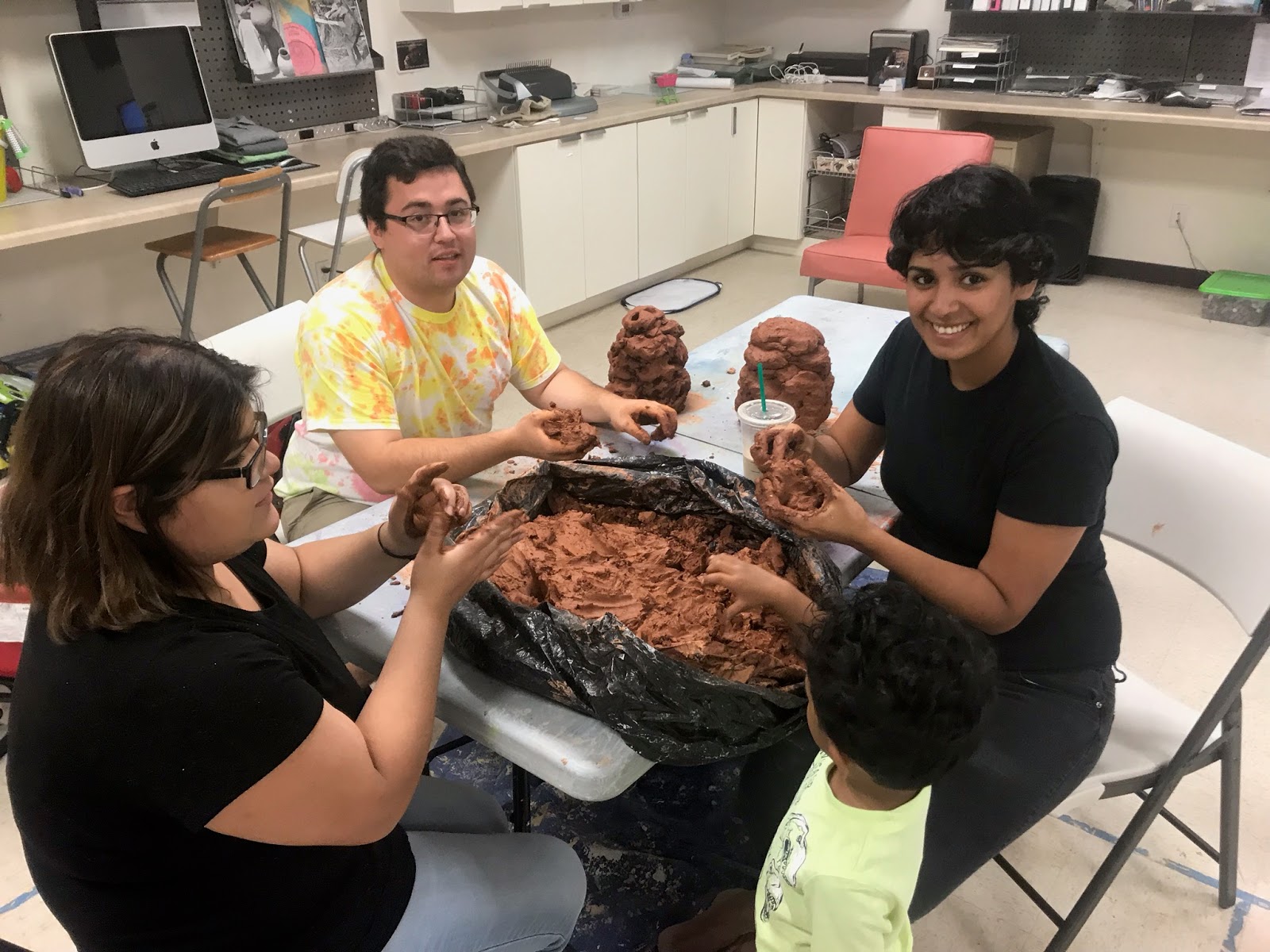
In one of our previous #TraditionalCraftDays guests used the traditional practice of coiled clay pottery making to make small bowls similar to the Kumeyaay ollas. Having dried and then fired those pots, guests were invited to return for their painting -- mixing raw, ground pigments to create paints and add color and life to their vessels!


Guests seemed to have a lot of fun choosing what pigments to use and what designs to include on their pots. Some guests created intricate designs with snakes and polka dots, while others tried their hand at abstract painting. We were even asked to mix pigments to create custom colors! After painting, guests trickled through the exhibits to learn more about the Kumeyaay and their traditions. 


Modern Pottery, Ancient Traditions


But the Kumeyaay didn’t visit their local craft store for paint or canvas like we do today. So how did they do it?


Knowledge of the local geology was key!  From the rocks and minerals of the region, new colors and slips (paints) were created.  Indigenous groups in the area made red and yellow pigment from red ochre deposits, sourcing the material from hills and red clay deposits across the state.  This ochre was then ground in sandstone or basalt mortars. Sources for red ochre were kept secret between the tribes.


For those of you whose favorite colors are more blue-green, well guess what, indigenous groups knew how to make those colors too! Blue pigment was commonly made from blue azurite, and green was made from green malachite. However, blue azurite tends to become malachite overtime, meaning some of the blue azurite paint could have turned green over long periods of time.


With the exception of a few indigenous groups, black was typically made from charcoal. It is noted that some groups believed charcoal from ash trees and oak bark were the best for making black pigment. Can you take a guess how white pigment could’ve been made? White pigment was usually made from burnt and pulverized seashells.


Even though we did not search for our own red ochre deposit, harvest the red ochre, and then grind it into a powder-like substance, we sure did have a ton of fun sharing this knowledge with the community during our first pottery painting #TraditionalCraftDays.


Tuesday, May 26, 2020

A New Donation promises SIdewalk Astronomy at IVDM

~ Michael Rood, Amateur Astronomer & IVDM Volunteer


The desert’s night sky has been a focus for Indigenous Folklore, Greek Mythology, and just good nighttime entertainment for people throughout human history. It only takes one visit to Ocotillo and the Imperial Valley Desert Museum during one of its Stargazing nights to appreciate how impressive the desert nighttime sky can be. Children and adults all stare with wonder into the universe; they may be listening to cultural stories of old, imagining pictures made by stars, or listening to astronomy science, but it is always a relaxing and enjoyable experience. The desert’s nighttime sky is the window through which anyone can view the universe.

Recently, through the diligent efforts of Executive Director, Dr. David Breeckner, the Imperial Valley Desert Museum has received the donation of a 30 inch Dobsonian telescope.  This telescope is huge, standing at nearly 10 ft in height!  Amateur astronomers are usually very satisfied with the results of six to ten inch telescopes.  A 30 inch mirror telescope is simply incredible and could take astronomy nights at the museum to a new level.

A Dobsonian telescope is an altazimuth-mounted Newtonian telescope popularized by John Dobson in 1965. The design is optimized for observing faint, deep-sky objects such as nebulae and galaxies. Dobson built telescopes through his hobby of instructional “sidewalk astronomy.” He set up his telescopes on sidewalks in San Francisco for any passerby to view for free. He took satisfaction in connecting people caught up in their busy urban lives to wonders of the universe. He is credited with being the originator and promoter of the design of large Dobsonian telescopes that revolutionized telescopes available to the amateur astronomer.


What does IVDM have planned with this new telescope? Dr. Breeckner is researching possible grants and additional donations that could assist in building a structure for housing this telescope at the museum, providing it a forever home where Dobson's tradition of “sidewalk astronomy” can be continued.

Any ideas for this next step would be appreciated. For any interested parties, remember that the Imperial Valley Desert Museum is owned and operated by the Imperial Valley Desert Museum Society, Inc. which is a non-profit 501(C)(3) qualified corporation that can provide tax credits and related tax benefits to donors.

Thursday, May 7, 2020

Museum Staff Working from Home During COVID-19


Museum Staff Working from Home

Here at Imperial Valley Desert Museum, its Education staff have been hard at work to redefine what it means to be community leaders8 and educators in the time of social distancing and COVID-19.

IVDM closed its doors to the public on Friday, March 20. That same day, it transitioned all of its staff to a work-at-home environment. Their new mission? Find new ways to engage our audiences virtually and share the history, heritage, and science of our deserts from the safety of home. Just because its building is closed does not mean the same for the museum itself.

As the Education Coordinator I am grateful for what the museum and board is currently doing for us by allowing us the privilege of working from home. As this pandemic continues, a lot of people have lost their jobs, or are currently working jobs that put them in danger every single day; my utmost respect and appreciation goes to these essential workers.

Curriculum Development

One of the greatest challenges facing educators right now is the transition to an online classroom. Every day, these teachers are reinventing education in this country. They are hungry for new, trustworthy content to share with their students. The Education Staff and I are currently working to answer this need: developing new online virtual curriculum and revising current curriculum for the next season of field trips and education programs.


We are utilizing this time to create online content and lessons to provide support for teachers and students during this time. We are also making sure the existing education material reflects the most updated and current version of California State Standards.


How does the Education Staff feel about working from home?

The Education Staff shared some insight on what their experience working from home has been like:


Cory Fitzsimmons
Working from home has been a great experience overall. As a prospective teacher, I see that it's really valuable to be able to create online educational material.


                                      Luis Landeros
I have been learning so many new things either from doing research or writing outlines and scripts, which I never thought this was something I would get to do! It is such a different experience and working from home is what is needed in such hard times so it is what we will keep doing to help the museum keep moving forward!


                                        Charles Kirby
Of course, I would prefer being all together, but I feel everyone is just as committed to getting the work done. I also feel that my colleagues and supervisors are always available if needed and have been super willing to work with me if I have any issues or concerns.

Friday, February 28, 2020

Ocotillo Blooms 2020!


Each spring, the desert comes alive as the wildflowers bloom and transform the Yuha Desert into a colorful canvas, and the best place to celebrate this is at the Imperial Valley Desert Museum!

On Sunday, February 23, the IVDM hosted its 2nd Annual Ocotillo Blooms! – a community based event designed for families and children to come out to the Museum and celebrate wildflowers blooming in our desert and learn the many values of native plants.

This year we had 170 attendees, many of them being families with young children. The event included food,music, vendors, painting, a water color activity, scavenger hunt, desert biome lecture, and butterfly release. We were able to release 100 painted butterflies into our desert!


Our vendors included, Vince & Victor Zazueta, who were set up with a compost station, and natural products for sampling and purchasing. Some of the items available were loofahs, seeds, and fresh homemade lemonade! Imperial County Behavioral Health Services Positive Engagement Team (P.E.T.) provided a booth with their therapy dog, Bo, who made many friends including our resident tortoise Speedy! Loko Bean Cafe's coffee cart had many refreshing drinks to offer like Italian soda, iced coffee, and chamangos, as well as cotton candy.


It was a beautiful day in the desert to celebrate the yearly phenomenon known as the desert bloom. A desert bloom occurs when enough rainfall penetrates dormant seeds and causes them to grow quickly before desert conditions cause them to dry out again. We received a small wave of rainfall two weeks prior to the event, which caused the brittlebush, Ocotillo, and creosote to thrive surrounding the museum. We look forward to what it's in store for us next year!
Thank you to our sponsors El Centro Costco, the Rose Foundation for Communities and the Environment, participants, vendors, staff, and volunteers for making this event possible!

Sunday, February 2, 2020

Meet and Greet! IVDM visits the San Diego County Archive

~ Kristin O'Lear, Curatorial Research Fellow

The staff here at IVDM has been on the go-go-go! This past week I was fortunate enough to be invited to a behind-the-scenes tour of the new San Diego County Archives before they open to public on Monday February 3, 2020.


Here at IVDM we understand just how important a facility designed for preservation is! About to undergo our own renovation of collection spaces here at the Museum, the sneak-peek of the new archives facility was an opportunity for me to meet and network with other institutions in the greater San Diego area. This allowed for me as acting curator to learn about collection management policies utilized at other institutions and steps they have taken to ensure the preservation of their collections for future research and use. 


From a collections perspective, the building is a Curator's dream! The space dedicated to archival material is roughly 5000 square feet and built with the intention to grow as San Diego County (SDC) grows, setting aside space for approximately 50 years of SDC records in addition to the archival collection that is currently being housed off-site!  The building also provides a spacious reading room that allows multiple researchers to utilize the space at one time.


Although IVDM is a smaller institution and our collection needs differ than those of SDC, the preview of the new archives facility reinforces our commitment to the highest standard of care for our collections. As a curator, it makes me more conscious of IVDM's needs as a smaller museum to make sure we take the best possible care to preserve our history!

Stay tuned for future posts as we begin our renovation project in March! We can't wait to show you what we have in store(age)!

Thursday, December 12, 2019

Life Along the Border: A Local Perspective Reflects on a National Conversation

~ Kristin O'Lear, Curatorial Research Fellow


As temperatures in the desert begin to cool down, things are heating up at the Imperial Valley Desert Museum!

We just opened our new temporary exhibit Life Along The Border, featuring the photography of local artist and photojournalist, Jimmy Dorantes.  Growing up along the border in Calexico, CA, Mr. Dorantes captured the reality of what was going on, literally, in his own front yard. Mr. Dorantes' work has been featured across national news outlets such as the Associated Press and Time magazine, as well as partnered with major institutions such as the Smithsonian Institute. We are excited for our partnership with Mr. Dorantes and proud to showcase five decades of his work. 

Since my arrival in the desert two months ago,  Life Along The Border has been my labor of love. It's not very often during exhibit development one gets the opportunity to work with the artist whose photography is at the center of the exhibit, but that's exactly what I've been fortunate enough to experience. Mr. Dorantes worked closely during the exhibition's development, lending his expertise and perspective. Working with him has been a real highlight during my time at the Museum so far. Growing up primarily on the East Coast, discussion of the border/border wall has always been abstract and distant.  Conducting research for this exhibit, especially from a local perspective, has shown me just how complex the border, border wall, and the people living along it, actually is.
 
With this exhibit, IVDM is venturing into new territory. The exhibit will be open until March 1, 2020 and will then travel across the United States, becoming the first exhibit developed and curated by IVDM that will travel nationally and bring a local perspective to a national conversation. We at the Museum encourage you to take time to come and see the exhibit before its whisked away! 


Saturday, November 9, 2019

We Will Ocotillo Rock You!

~ Rebecca Santiago, Education Specialist

James Egger cutting a geode
Your Imperial Valley Desert Museum team rocked out at the 2019 Ocotillo Rocks! event providing educational geological speeches, hikes and games. Ocotillo Rocks! focuses on the importance of geology not only in the desert, but also the adjoining mountains of the desert and dunes on the eastern side of the Imperial Valley. We brought along our partners at the Imperial Valley Gem and Mineral Society to showcase the proper skills needed to be a successful gold miner, part a geode to reveal the hidden beauty within a plain rock, and spin a wheel of fortune for a chance at winning desert treasures, including geodes and rocks native to the desert.

Luis showing soapstone to a visitor
James Egger, Vice President of IV Gem and Mineral Society, shares his love and passion for desert rocks by cutting plain white and buffed rocks to expose the sparkling build up of crystals within, showcasing the hidden beauty that lies in our deserts. Along with Egger's passion for rocks, came the IV Gem and Mineral's society's passion for gold! Visitors were taught the proper methods to pan for gold guaranteed to find a nugget every time. After the thrill of finding gold or hidden beauty came an educational talk done by Education Specialist, Luis Landeros. His lecture was intriguing, interactive and inclusive of the visitors eager to know where their favorite rocks resided on the scale of rock labels. Last but not least, hiking the trails along the wash just behind the museum building, Cory Fitzsimmons and myself showed our visitors where to find milky quartz, petrified wood, sandstone and a few natural habitats of animals residing within the sands. We even had a young hiker find a beautiful piece of salt turned blue by the natural introduction of copper, leaving him excited to find more!

 Once hikers were done exploring the different mysteries of the desert, they were welcomed by the warmth of fresh lunch and cold beverages along with a fun activity for those who enjoy arts and crafts. The Petrified Wood painting booth was led by Education Coordinator Lesliee Parker
, where learning was made fun by letting the artistic juices flow. By painting a petrified piece of wood, visitors were not only learning about the process of minerals overtaking wood but also being able to create their own pieces of history. Ocotillo Rocks! is an event of its own that pushes the importance of education of not only the animals residing in the deserts of Ocotillo, but also the often overlooked and stepped on rocks that make up the majority of it. We thank everyone that came to enjoy this event with us as well as those who volunteered their time to be with us to make a spectacular event.


Sunday, October 13, 2019

East Coast, West Coast: A Curator on the Move!

Hello everyone!

My name is Kristin O'Lear and I am the new Curatorial Research Fellow with the Imperial Valley Desert Museum.  I am originally from Macomb, Michigan and received my bachelor's degree from Michigan State University in International Relations and German.  I am currently finishing my Master's degree in History, with a concentration in Public History, at East Carolina University in North Carolina.

Before working with IVDM, I served as Pre-Professional Intern at Mystic Seaport in Museum in Mystic, Connecticut.  I worked directly under the Director of Exhibits and as part of my work I developed audience evaluation tools in an effort to understand how visitors engage and perceive the exhibits they visit.  As a secondary role, I worked closely with Curatorial Affairs, contributing to the photography exhibit, When This You See, Remember Me.  As a graduate student at East Carolina University, I had the great privilege to assist in the research, design, and fabrication of an exhibit centered on a local World War II Naval Aviator at the May Museum in Farmville, North Carolina.

 
IVDM is unique from other museums and historical sites I've previously worked at.  I am impressed with the museum's mission to be more than just four walls and serve not as a space for interpretation, but rather as a platform highlighting local history and culture, particularly through its community outreach and educational programs. In my short time here in Imperial Valley, its clear that its history is rich and complex. I am excited to be new member of the team here at IVDM and be a small part of the museum's effort to promote and preserve the history of Imperial Valley!


Wednesday, October 2, 2019

New Beginnings

~ Ryan McHale, Head Curator

Hi Everyone,

My time here in the desert has come to a close, and I'm beginning my next adventure. I'm moving to Ketchikan, Alaska to be the Curator of Exhibits at the Tongass Historical Museum and the Totem Heritage Center! It is a bittersweet goodbye. 


I began last September as a Curatorial Fellow right out of graduate school, still wet behind the ears and ready for a challenge. As the Curatorial Fellow I was given the freedom to find what interests me and pursue it. 

I couldn't have asked for a better opportunity to gain the practical experience I needed. IVDM understands that learning by doing teaches you something you can’t gain from a textbook. 


As Head Curator I was challenged with wearing many hats. In this role, I learned the importance of adaptability and the need for cooperation and collaboration between staff members and departments. 


IVDM has taught me that after housing and caring for collections and historical artifacts, museums should be cultural and community centers. They should be places where people can come together and socialize, explore ideas and cultures, and build stronger connections with each other and their local community. 


After my time at the IVDM, I want to focus my career on traditionally marginalized histories and bring underrepresented voices to the forefront of the museum experience. I hope to create informative and culturally relevant exhibits that inspire and connect us to our shared history.

This past year has been an invaluable experience and has prepared me for my next step. I am grateful for my time here at the Museum and for the friends I have made both on staff and within the community. Thank you IVDM for the opportunity to grow, and thank you Imperial Valley for welcoming me with open arms! I look forward to the new horizons that lie ahead and will always remember where I have been. 

"Every new beginning comes from some other beginning's end." - Seneca 

Wednesday, September 11, 2019

Meet the Team: A New Class of Educators

-Lesliee Parker, Education Coordinator

As we say goodbye to summer and parents, children, and teachers shift back into their school year routines, your IVDM education staff are preparing as well.  Over the past year we've had more change in our education department than in the last four years. So let's talk a little about our Education Coordinator and Education Specialists -- Lesliee, Luis, Cory, and Rebecca -- and introduce or re-introduce you all to the amazing members of our team this school year.

(Left to Right) Rebecca, Cory, and Lesliee reconstituting red clay.
If you've picked up a copy of the Spring 2019 edition of Imperial Valley Alive!, you've seen a picture of our curator, Ryan, showing a history student cassettes from the Morlin Childers collection.  This excited student is Rebecca Santiago, one of our newest additions
Rebecca and Lesliee reconstituting red clay.
 to the team.  Rebecca attends SDSU's Calexico campus and is currently working on a Bachelors in History.  With this degree, she hopes to pursue a career in teaching or further her education through Museum Studies, specifically focusing on either curation or education.  We're very excited to accompany her on her journey.  Rebecca identifies as an American-Mexican-Puerto Rican and has learned about many different cultures thanks to her father's military career.  She is most interested in seeing the different ways history affects young students and is excited to help them learn how history isn't just something that happened in the past, but something we're creating right now!

Cory at Ocotillo Water Day.

Cory Fitzsimmons recently graduated from UC Santa Barbara with a Bachelors in Biochemistry and a minor in Mathematics Education.  He is interested in becoming a high school chemistry teacher here in the Imperial Valley.  One of Cory's goals is to help our community reconnect with nature, specifically nature right at our fingertips that we somehow overlook every day.  This is why he's excited to be part of the team.  Aside from his amazing professional goals, Cory has a few hobbies including playing the trumpet, tennis, and video games.  He also sketches, paints, dabbles in gardening and, as if that weren't enough, he's always willing to help out his friends with their own projects.  

Luis leading an educational hike.
Don't worry, it's not all new faces this school year.  Luis Landeros has been with us for a year now.  Happy Anniversary Luis!  Over the last year, Luis has been key in achieving inter-departmental goals; in addition to being the longest-serving employee on our current education team, he's a constant aid to every department in the museum.  He truly is a jack-of-all-trades!  Luis is currently attending Imperial valley College, majoring in Mechanical Engineering for Transfer.  His goal for this year is to make an impact with under-served youth through the museum's partnership with the Imperial Valley Probations Department.

Lesliee leading tie-dye booth at
Ocotillo Water Day.


Last but not least, Lesliee Parker is the IVDM Education Coordinator as of November 2018.  This year has brought a lot of opportunities to learn from, educate, and connect with our community.  Before officially joining the team, Lesliee has volunteered with the museum since 2015.  The museum staff really are like a part of the family at this point.  Lesliee strives to meet and surpass the mission and vision of the Imperial Valley Desert Museum every day.  Next time you're driving by Ocotillo, try to stop by and meet our education staff in person.  Every encounter is a learning opportunity!

Wednesday, September 4, 2019

Museum of Tolerance

~Marcie Landeros, Museum Manager

Kris Haugh in Anne Frank Exhibit
This week, myself, IVDM’s Education Coordinator Lesliee Parker, and US Navy Public Affairs Officer Kris Haugh, took a road trip to the Museum of Tolerance in Los Angeles, California, for some professional development. Kris is also the Communications Director for the Center for Genocide Research and Education, along with working on his PhD in Holocaust and Genocide Studies, so this was a fantastic opportunity to work with our community partners to expand our understanding of history, and explore how other museums create exhibits that focus of challenging history. 

Gas Chamber inside of Museum of Tolerance
The Museum Tolerance had 3 exhibits running, one focused on the Holocaust, one focused on Anne Frank specifically, and one that covers the bigger ideas of hate crimes, genocide, and violence, called The Hall of Tolerance. While all three were fantastic, the Holocaust exhibit was the most moving for me as a museum professional, and for my own personal experiences. Having family of both German and Jewish descent, I found myself deeply moved by the exhibit, particularly as I walked through a hallway marked for children, and walked into a gas chamber. 
Lesliee Parker in Anne Frank Exhibit 


The Anne Frank exhibit I found fascinating, because it a much lighter feel. When talking about her story, it is easy to imagine it as very dark, and terrifying, but after reading her words, and the words of those who truly knew her, I realized that telling her story in that way doesn’t begin to do her justice. She kept a positive outlook, even when things were terrifying for her, and the lighter air of the exhibit reflected that. It was an amazing trip, and I look forward to returning in the future. 


Tuesday, August 6, 2019

Nativa! An IVDM roadtrip to celebrate living cultures

~ David Breeckner, Executive Director 

Some days you just have to get out of the office!  At Imperial Valley Desert Museum, we strive to be more than just a building with four walls.  Sometimes, that means a road trip to work with others on their own turf.  On Sunday, August 4, IVDM staff made the three hour drive south of the border to the coastal town of Ensenada for its 15th annual Nativa! festival.


Bringing together indigenous artists from across Baja, the weekend-long festival featured traditional crafts, foods, songs, and dances of the Kumiai, Pai Pai, Kiliwa, and Cucapa [sic].  Its purpose?  To spread, strengthen, and celebrate their ancestral traditions of crafts!  Over 60 stalls and vendors were present across the day with everything from pottery to reed, pine, palm, and willow basketry, hunting tools, stone and metal sculptures, traditional herbs and medicines, and loads of food and drink.

 
IVDM staff had a blast exploring around the festival, meeting the artists and learning more about their process and the crafting itself.  Sampling not only traditional dishes like shawii (a ground acorn paste that's a high-protein superfood), staff also got to experience the continued evolution and growth of these traditions with more modern staples.  From homemade wine to the bitter grounds of Ajak Kuneey A'aal (a new, acorn-based coffee), all sampled while watching a large group sing their traditional bird songs, the flavors and offerings were as rich as the day itself.  


The festival was an incredible and busy day with plenty to see, do, and experience.  It truly was something amazing to see so many come together to celebrate the rich history and culture of the region's indigenous peoples, and to explore the new ways in which that culture continues to grow and thrive today.  As both a tribute of their past and a celebration of the tribes' present and future, I'm thrilled that IVDM was fortunate enough to attend!